Commercial Leak Detection in Camden, NJ

A commercial roof leak is, as one roofing trade magazine puts it, "rarely the brown spot on the ceiling tile." Water gets in at a seam, a curb, or a drain, then travels sideways under the membrane — the stain in your stockroom can be yards away from the actual hole. Commercial leak detection is a different discipline from residential work: bigger roofs, bigger consequences. A missed leak in a storefront isn't just a repair bill — it's tenant complaints, inventory damage, business interruption, and liability. That's what commercial leak detection is: find it fast, document it properly, and keep your doors open while we do.
How Commercial Leak Detection Works in a Camden Building
The commercial leak detection pro sequence never starts with equipment. Roofing firms that do this for a living run the same four stages, and we follow them:
- Interview. We talk to you, your facility manager, or your tenants first — when did it start, what weather triggers it, where does it show, what's been tried. The leak's history is the cheapest diagnostic tool there is.
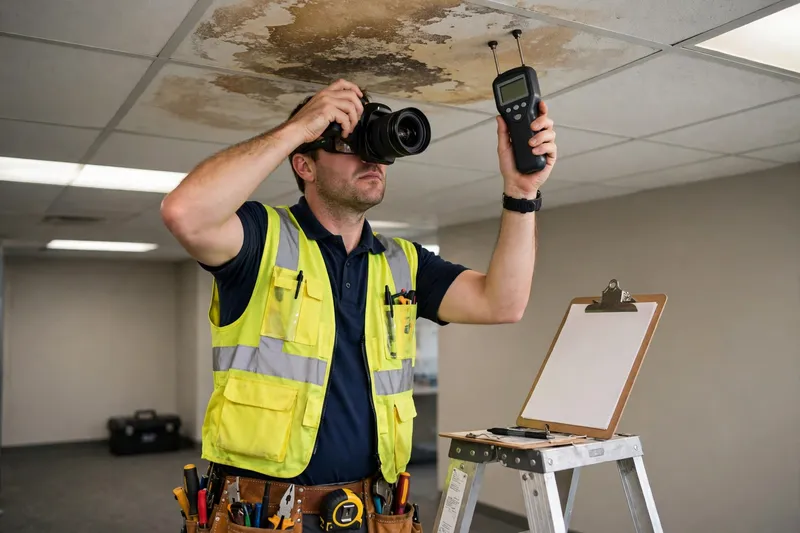
- Interior. We read the building from the inside: ceiling tiles, decking, structural elements — sometimes just tracing the pattern of stained tiles tells us which direction the water traveled.
- Exterior. Then we go up: penetrations, seams, drains, scuppers, flashing, rooftop units. The four usual culprits on a commercial roof are failed membrane seams, flashing around HVAC curbs and rooftop units, ponding water from clogged drains, and punctures — from hail or from other trades walking the roof.
- Instrumented testing. Only then do the instruments come out — and the instrument depends on the roof.
Commercial Leak Detection Instruments: What Each One Actually Does
Commercial buildings get surveyed with methods most homeowners never see. Here's the honest version of each:
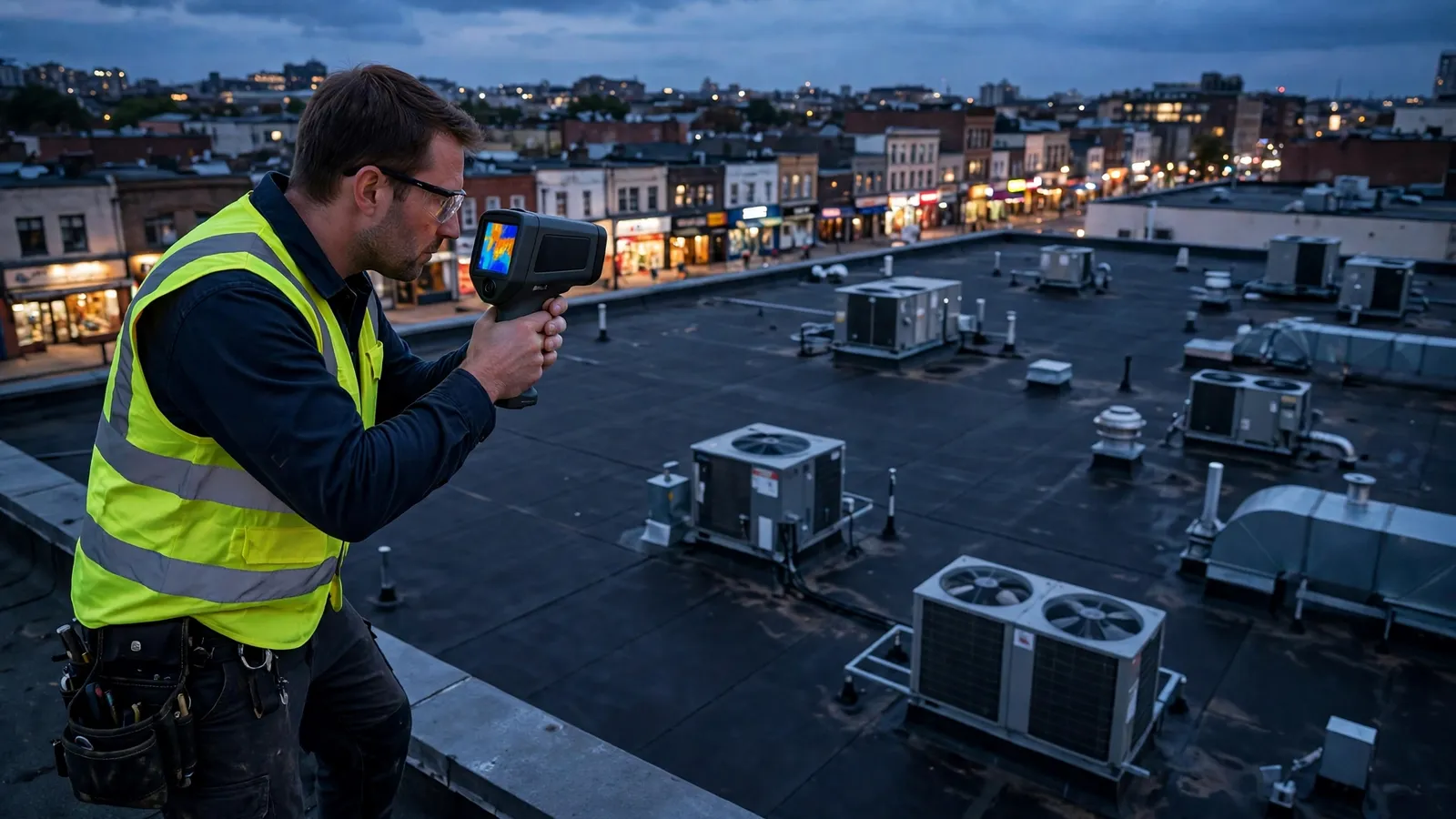
Infrared thermography is the workhorse on large flat roofs. Wet insulation holds heat differently than dry, so an after-sunset scan maps moisture pockets across whole roof sections without cutting anything. The working conditions: 2–4 hours after sunset, clear sky, a sunny day before, more than 15°F of day-night differential, a dry roof surface, low wind. Wet areas read warmer at night and cooler by day. One veteran inspector with 100+ documented IR surveys reports finding shower-pan, bathtub-drain, and water-piping leaks by IR that showed zero visible staining — "found just by sheer accident with the use of the IR camera."
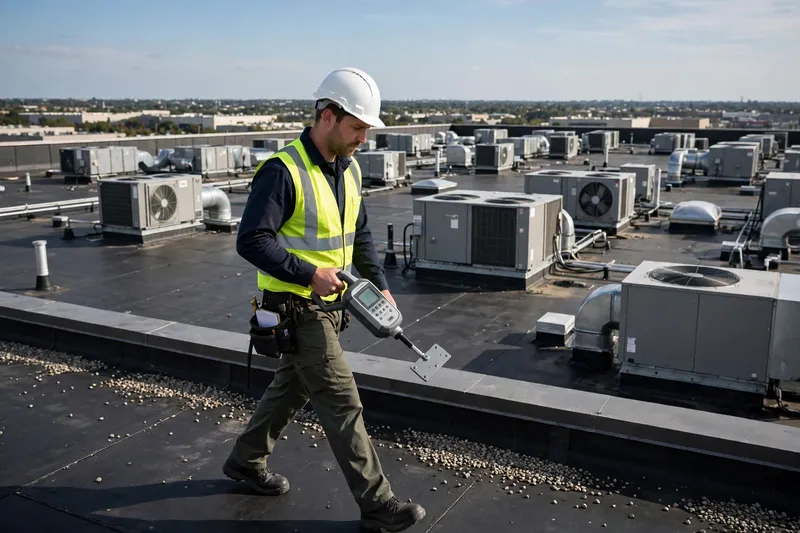
EFVM — electronic field vector mapping — pinpoints membrane breaches directly. The membrane is wetted, a perimeter wire goes in, a 40–60V DC pulse generator energizes the circuit, and the tech scans with a wand: where current flows through a breach to the grounded deck, the alarm sounds and the breach gets marked with survey paint. No cutting, no flood testing. (It can't test conductive membranes, and metal in contact with the membrane disrupts readings — honest limits, stated upfront.)
Capacitance/impedance surveys grid the roof with a meter — a skilled tech covers up to 100,000 square feet a day, marking concerns on the roof and on a plan. Nuclear backscatter serves as secondary verification on institutional and state work. And core sampling — cutting one small targeted section — is the honest invasive backstop that confirms what an IR or capacitance anomaly actually is. Controlled flood testing (damming sections, hosing low-to-high on a dry day) triggers leaks on demand and rules out HVAC, plumbing, or drain culprits before anyone blames the roof. The formal standards behind all of this: ASTM D5957 for IR inspection, D7877 for electrical leak detection, D7954 for capacitance surveys, C1616 for core verification.
The Four Culprits — and New Jersey Freeze-Thaw
On Camden's commercial roofs, the failure pattern is systematic, not random. Freeze-thaw hits the same five places every winter: membrane seams, penetrations (HVAC curbs, vents, pipes), drains and scuppers, perimeter flashings and edges, and low spots. Blocked or frozen drainage is the single most common root cause of ponding — and ponding is the engine: water sitting more than 48 hours is the industry's red-flag rule, degrading membrane, rotting insulation (wet insulation loses most of its thermal value), corroding steel decks, and backing fasteners out.
A published case from a NYC flat-roof specialist shows the diagnostic chain: a mixed-use building leaked only during northeast storms. An IR scan after a rainstorm showed a cold band running from a rooftop HVAC curb toward the parapet; a moisture meter confirmed it — a 6-inch seam separation at the curb where wind was driving water under the flashing. No flood test needed; one pinpoint repair. That's what commercial leak detection is supposed to produce: not "your roof leaks," but here, exactly, and here's why.
The NJ-specific mechanism: NJ contractors describe local freeze-thaw cycles as "brutal" — water gets into a flashing gap, freezes, expands, and cracks the seal wider every cycle. NJ American Water's winter advisory, datelined Camden, tells property owners to locate and test main shutoff valves and keep thermostats at 55°F. Winter is when commercial buildings in this city earn their leaks.
Camden's Commercial Stock Is the Target Profile
Walk Broadway and you're looking at the exact building profile these methods were built for: century-old brick storefronts with flat or low-slope membranes and rooftop units. Live listings tell the story — a 1945 brick building with a flat roof on S Broadway; four combined 1928 buildings on Broadway totaling ~13,000 square feet, retail with apartments above; gateway-area retail stock built 1900–1935 dominating the corridor. The city's own economic development strategy plans to rehabilitate about 10 abandoned storefronts and commercial buildings along Broadway and MLK Boulevard, with improvement loans for ~15 more stores — the city itself recognizes an aging commercial stock that needs work.
And the bar is rising next door: the former RCA Victor headquarters — eight stories, 80,000 square feet — is being gut-renovated to Class A office, and the Rutgers-Rowan corridor is pushing new retail along Broadway. When new investment lands beside century-old buildings, the older ones get judged harder — by tenants, insurers, and buyers. A documented commercial leak detection survey is how an older building proves its roof.
Commercial Leak Detection in Camden, NJ: Four Jobs Behind Every Survey
A commercial survey is four jobs wearing one coat: work around your hours, settle whose line it is, cover the building's full scale, and document everything like a claim is coming. Here is each one.
After-Hours & Low-Disruption Visits
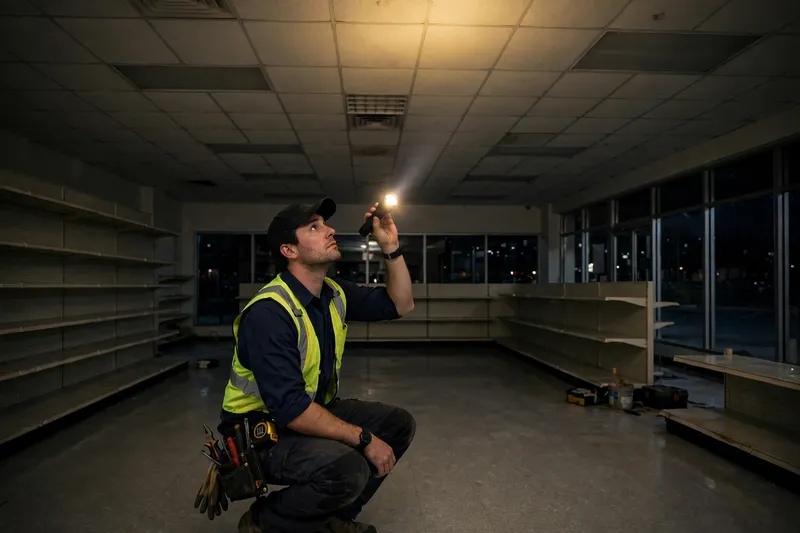
Your doors stay open. Interviews and interior work happen on your schedule, and roof surveys — especially infrared, which needs the window a few hours after sunset — happen when the building is quiet anyway. The whole point of the visit is answers without a closed sign on the door: findings first, disruption last.
Shared-Line Leak Isolation
In a multi-tenant building, water crosses property lines as easily as it crosses ceilings — one unit's shower diverter becomes the mystery drip in the unit below. We isolate the building as a system: this unit's line, the shared stack, the risers, the roof. And the answer comes with instrument readings behind it, because a located source is the only version of the truth either side's insurer will accept.
Large-Diameter & High-Volume Lines
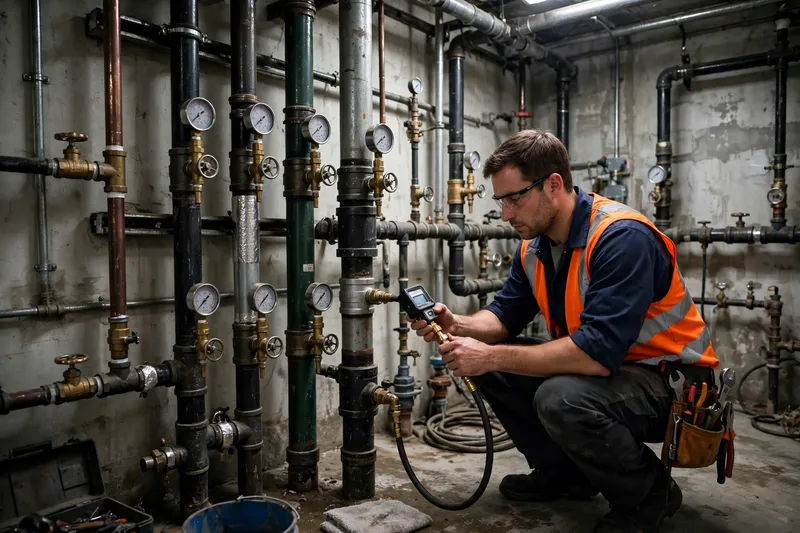
Commercial scale changes the instruments, not just the stakes. Whole roof sections get mapped in a single infrared pass, and a capacitance grid can cover up to 100,000 square feet in a day — seams, drains, and penetrations surveyed as one system instead of stain by stain. Bigger buildings hide water better; the survey has to be bigger than the hiding places.
Documentation for Insurance & Liability
On commercial property, the paperwork is half the product. We work the 48-hour protocol: the cause of loss pinned down early, the source photographed before anyone repairs it, moisture mapped at the start with dated readings to follow. A sudden burst and a slow leak sit very differently in a policy, and the difference gets settled by evidence, not argument — our report is built to be that evidence, for your insurer, your tenants, or your lease.
What Commercial Leak Detection Costs in Camden, NJ
No Camden or New Jersey market pricing is published for this work. Attributed national and other-market ranges:
| Service | Published range | Source |
|---|---|---|
| Professional water leak detection visit | $100–$500 (typically $200–$400) | Angi 2026 |
| Infrared roof inspection (residential scale) | $300–$1,500 | Published inspector ranges |
| Infrared roof survey (large commercial) | $2,500+; some charge $0.20–$0.50/sq ft | Published inspector ranges |
| Minor leak repair | $300–$1,000 | Angi 2026 |
| Structural repairs | $10,000–$30,000+ | Angi 2026 |
| Mold remediation | $2,368 average; up to $30,000 in cavities/ductwork | Angi 2026 |
The framing a Toronto commercial roofer uses is the honest one: a survey costs pennies per square foot and catches problems that cost several dollars per square foot to fix. A commercial leak detection visit at $200–$400 is roughly 2% of the average water-damage insurance claim. Business-side, water and freezing damage is 15% of business property claims at a $17,000 average — and a first claim raises premiums 18–28% on average, with water damage among the fastest rate-pushers. Finding it early isn't just maintenance; it's premium protection.
Insurance, Tenants, and Liability
On a commercial property, the paperwork matters as much as the finding. The 48-hour protocol from Buildings.com: pin down the cause of loss early and honestly — a sudden pipe burst and a slow leak that ran for months sit very differently in most policies, "and the difference gets settled by evidence, not by argument." Photograph the source before anyone repairs it. Moisture-map at the start, take daily readings during drying — the burden of proving the loss sits with the insured, and our survey is built to be that evidence.
Know the coverage split: the landlord's policy covers the building — structure, roof, common areas — plus rental-income loss. It does nothing for the tenant's stock, equipment, business interruption, or liability, and who insures leasehold improvements is decided by the lease. On business interruption, carriers argue "necessary suspension" means total shutdown — but courts have repeatedly found that a substantial slowdown is enough. And the tenant-relations rule from the trade: "Tenants forgive the flood. What they remember is being left in the dark." A calm, dated communication log is your defense against disputes. Drying-to-standard documentation is your defense if a mold complaint surfaces months later. We document like the claim is coming, because on commercial property, it often is.
What Our Visit Looks Like
We start with your story, not our gear. When it started, what weather triggers it, where it shows, who's affected — the interview first, always.
We read the building inside-out. Interior tracing, then the roof: seams, penetrations, drains, flashings, rooftop units. Most commercial leaks announce their mechanism to a trained eye before any instrument comes out.
We survey, then verify. IR after sunset for flat roofs, EFVM or capacitance where the membrane suits it, core samples only where verification is needed. Anomalies get confirmed — moisture meter, second method — before we mark anything.
You get documentation, not just a finding. Moisture maps, readings, photos, and a plain-English report your roofer, your insurer, or your tenants can actually use. And we schedule around your business — the survey happens without shutting your doors.
For residential rentals rather than commercial buildings, see our leak detection for property managers and landlords in Camden, NJ — the same documentation discipline, for single-family rentals, twins, and small multi-unit buildings.
Commercial Leak Detection FAQs for Camden Building Owners
Scale, systems, and stakes. Commercial means flat and low-slope roof membranes, rooftop units, multi-zone plumbing, and tenants — so we use commercial methods (infrared roof surveys, EFVM, capacitance grids, core verification) and we document everything to insurance standard, because on commercial property the claim is often coming.
Yes — that's part of the service. Interior work and interviews happen on your schedule, and roof surveys (especially infrared, which needs the after-sunset window) happen without disrupting operations. The goal is answers without a closed sign on the door.
Yes. Infrared, EFVM, and capacitance surveys are all non-destructive — they map moisture and breaches across the full roof without a single cut. Core samples come only afterward, in small targeted spots, to verify what an anomaly actually is before anyone spends repair money.
Rarely. Water enters at a seam, curb, or drain and travels sideways under the membrane — the stain can be yards from the hole. Chasing the stain with patches is how commercial roofs get 'repaired' three times. We trace the actual entry point.
Published ranges: infrared roof inspections run $300–$1,500 at residential scale and $2,500+ for large commercial roofs, with some inspectors charging $0.20–$0.50 per square foot. There's no Camden-specific rate card — call (856) 245-0967 and we'll scope your building. The honest framing: pennies per square foot to survey, dollars per square foot to repair what a survey would have caught.
That's what it's built for. We follow the 48-hour protocol: cause of loss pinned down early, source photographed before repair, moisture mapping at the start with dated readings through drying. Sudden bursts and slow leaks sit very differently in a policy, and the difference gets settled by evidence — we bring the evidence.
No — it's the target profile. Camden's commercial core is century-old brick with flat membranes and cast-iron-era plumbing: exactly the buildings where water travels sideways, freeze-thaw works the seams every winter, and a survey pays for itself. Age is the reason to survey, not a reason to skip it.
Yes — mixed-use and apartment buildings are core commercial work. Stack leaks, riser failures, and drain backups that affect the unit below are classic multi-unit patterns: one 6-unit building's mystery ceiling drip turned out to be an upstairs shower diverter that only leaked under pressure. We diagnose the building as a system, not the stain as an event.
A Commercial Leak Is a Business Interruption With a Plumbing Cause
Commercial buildings hide water better than houses do — above ceilings, inside chases, under slabs that carry a business on top of them — and they bill for it differently. The leak itself is a line item; the closure, the damaged stock, the tenant dispute over whose pipe it was, and the insurer’s documentation demands are the rest of the invoice, paid whether or not anyone itemises them. This city’s commercial stock is the target profile for all of it: older buildings, mixed-era plumbing, flat roofs over occupied space, and freeze-thaw working every joint. The owners who fare best treat detection as an evidence exercise as much as a technical one — the visit produces a located source and a record a lease, a claim, or a court can read.
Commercial detection, in published ranges
Who Calls Us About a Commercial Building
The building does not care about your org chart. The response has to.
Owner-occupiers
The water is over your own operation — stock, equipment, customers. You need the source found without shutting the building down to look for it: non-invasive methods first, work scheduled around trading hours, and findings documented for the claim your broker will file.
Landlords & tenants in a whose-pipe argument
Shared lines make shared blame, and both are expensive. A located source — this unit’s line, the stack, the roof — with instrument readings behind it is the only version of the truth either side’s insurer will accept.
Facility & property managers
You are measured on uptime and on files. A detection partner who works after hours, reports in writing per property, and prices from published ranges is how a 2 a.m. leak becomes a managed event instead of a quarterly surprise.
Managing a Building With a Leak? Let's Talk.
Every day a hidden leak continues, the damage — and the bill — grows. Call Leak Fix Pros now and get answers, not guesswork.
- Non-invasive pinpoint detection
- Upfront pricing, no surprises
- Serving Camden, NJ and nearby towns
Get Your Free Quote
Free quote · No obligation