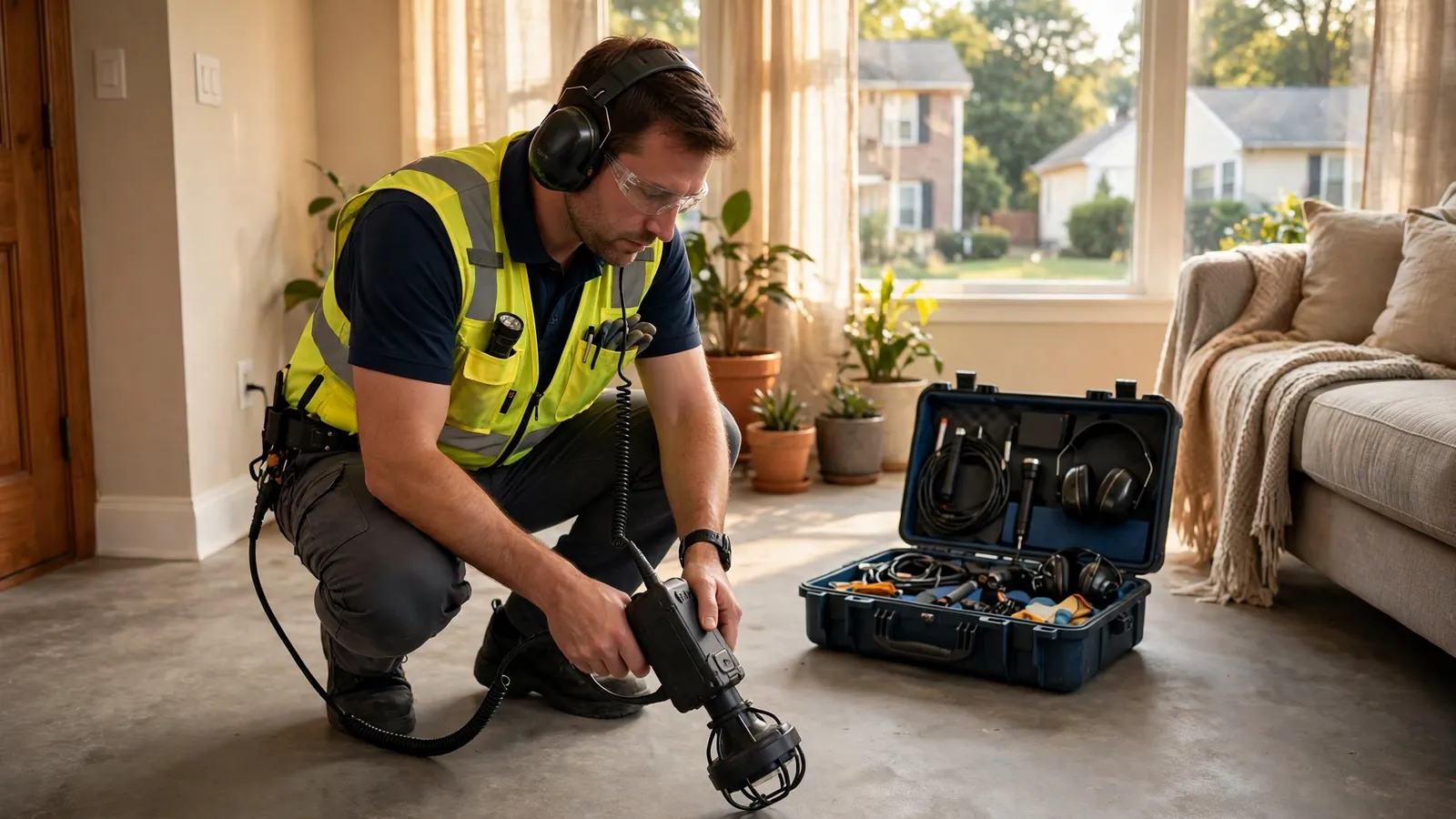
Here's the straight answer: a slab leak is a pressurized water line leaking underneath your home's concrete — and yes, we can pinpoint it without tearing up your floors. One honest note first: most Camden homes have basements, not Texas-style slab-on-grade construction, so when we talk about slab leaks here, we usually mean a line leaking under your basement slab or ground floor. We're Leak Fix Pros, and slab leak detection in Camden is work we do every week — acoustic listening gear, thermal imaging, and tracer gas for the leaks that play hard to get. We mark the break to within inches, so any repair opens one small area instead of your whole floor. Bill jumped for no reason? Warm patch on the floor? Water running with every tap off? Call (856) 245-0967 — water under pressure doesn't take days off.
Signs You Need Slab Leak Detection: Warm Floors & a Rising Water Bill
A slab leak hides under concrete — you won't see water, you'll see what it does. Here's what actually shows up, ranked by how much pros trust each sign:
Recognize two or more? That's when most Camden homeowners call us for professional slab leak detection — every week of waiting gives the leak more time to wash out soil.
- A warm spot on the floor. This is the single most useful early tell. A leaking hot-water line heats the concrete above it, and concrete conducts that warmth upward — the spot persists regardless of your thermostat. Hot-side leaks account for roughly 70% of slab leaks, which is why this sign triggers so many slab leak detection calls.
- Running water sounds with everything off. A pressurized supply leak runs 24/7, vibrating through the slab into your framing. Easiest to catch late at night when the house is quiet.
- Your meter is spinning. Shut off every tap and appliance, then watch the meter's low-flow indicator — usually a small triangle or sweep hand. If it creeps, water is escaping somewhere.
- Bill jump plus low pressure together. Either one alone has innocent explanations; the pair is the classic slab-leak pattern.
- Cracks, musty smells, damp spots. New cracks in flooring or baseboards, a musty odor near floor level, efflorescence on concrete, doors that suddenly stick — all downstream of soil washing out or moisture wicking up.
Two stories from the plumbing forums stick with us. One Oklahoma homeowner found their hot-side slab leak because the AC duct nearby was filling with water — "we could hear it hissing/trickling." They rerouted around it; a month later a second leak appeared in the same spot, because the cold line running alongside had been compromised by the same external corrosion. Lesson: one leak means check the neighboring line. And a veteran forum plumber put it bluntly about warm floors: the only times he'd seen concrete heated by a domestic hot-water line, it was either embedded in the concrete or leaking — "small leaks can start and stop by themselves… eventually it will get worse." Don't wait out a warm spot. Both stories end the same way: with a slab leak detection visit that found what ears and eyes couldn't.
Why Pipes Fail Under Concrete
Slab leaks aren't random. They're chemistry and physics, playing out over decades:
- Copper vs. concrete. The lime in concrete attacks copper from the outside. A veteran plumber with 6,000+ posts on the Terry Love forum, describing 1960s slab homes: the copper "would fail 20 years+" because "lime would corrode the copper." Same story in Long Island's Levittown — thousands of mass-built slab homes with copper lines failing as a generation.
- Abrasion. Hot water pipe expands and contracts with every heating cycle. That movement wears the pipe against concrete and gravel until it fails — especially where a line presses against a rough concrete edge and vibrates with normal flow.
- Electrolysis. Chemical reactions in soil, plus stray current from nearby electrical lines, corrode copper from the outside in.
- Soil movement. Ground swells with rain and shrinks in dry spells; every cycle tugs buried pipes. South Jersey's sandy soil is especially washout-prone — once water starts moving soil particles, it keeps going.
- High water pressure. It accelerates wear on pipe walls and joints, shortening the fuse on every weakness above.
Now map that onto Camden: nearly 63% of Camden homes were built before 1950. That's decades of lime, abrasion, and soil cycles working on original copper and galvanized lines. When a neighbor's 70-year-old system springs its first slab leak, it's rarely the last — which is why slab leak detection often pays for itself twice over, and why the repair-vs-repipe decision below matters.
How Slab Leak Detection in Camden, NJ Pinpoints the Break Without Digging Up Floors
Trade press lays out the sequence good crews actually run, and it's the sequence behind every slab leak detection visit we run — published in Contractor Magazine's guide to pinpointing slab leaks before breaking the floor:
Direct answer: rule out the cheap explanations first (running toilet, irrigation zone, hose bib, water heater weeping, AC condensate line), then run the meter test, isolate the leaking line, pinpoint with two methods — and only then decide how to access it.
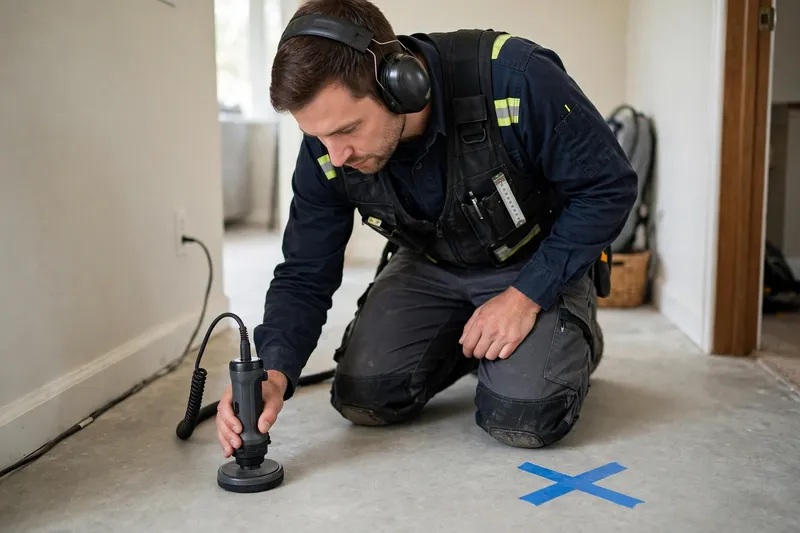
- We listen — acoustic is the workhorse. Escaping water hisses under pressure, and our ground microphones pick it up right through the concrete. We pressurize the isolated line first (higher pressure = louder signal), sweep a grid across the slab, and mark the loudest point. Hard flooring transmits sound well; thick carpet and pad fight us, so we adjust our slab leak detection approach to the flooring.
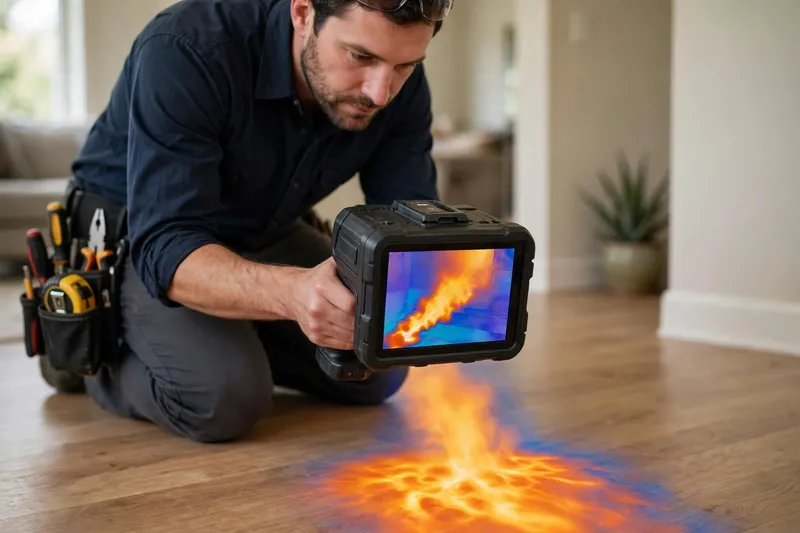
- We look for heat. A leaking hot-water line warms the slab above it, and our infrared camera shows that plume through your flooring — we trace the pipe's path and see where heat escapes. Cold-side leaks give a weaker signature, so we never rely on the camera alone.
- We run tracer gas on the stubborn ones. Drain and isolate the line, charge it with the industry-standard forming gas (5% hydrogen, 95% nitrogen — non-flammable), and let the tiny molecules migrate up through the slab. A gas-sensitive detector at the surface finds where they emerge. Best on plastic lines and low-pressure situations where acoustic slab leak detection struggles.
- We trace the actual pipe route. The skipped step crews regret: we find where the line truly runs instead of trusting old drawings or guesses, and pair it with a moisture map of the wet footprint.
"No single detection method is right for every leak, so we confirm with a second before marking a spot," the trade guide puts it — when the thermal plume, the acoustic peak, and the traced pipe route all agree, you cut once. A master plumber on the Terry Love forum gives homeowners the same advice we would: "You need a professional leak detector company, NOT a plumber who advertises 'leak detection.' He will have the means to test each line." Dedicated slab leak detection is the entire business we're in.
What Slab Leak Detection in Camden, NJ Covers, Job by Job
Pinpointing is the headline, but a proper slab leak detection visit in a Camden home is four jobs wearing one coat. Here is what each one involves — and why skipping any of them is how floors get opened in the wrong place.
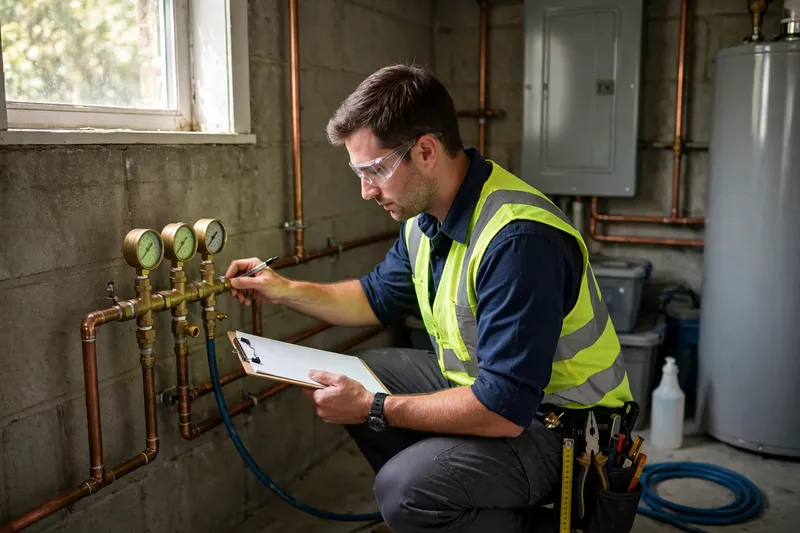
Pressure Testing & Line Isolation
Before we pinpoint anything, we prove the leak is really under the slab. We run the meter test, then pressure-test and isolate the hot and cold lines one at a time — and rule out the cheap impostors first: a running toilet, an irrigation zone, a weeping water heater. Plenty of suspected slab leaks turn out to be none of those things, and this step is what keeps a floor from being opened on a guess.
Under-Slab Pipe Pinpointing
This is the job the visit exists for. We sweep the slab with ground microphones, cross-check the loudest point against the thermal picture and the traced pipe route, and mark the one spot where all three agree. Your plumber opens a single small hole in the right place — not a trench across the kitchen while everyone hunts.
Hot Water Line & Manifold Leaks
A warm patch of floor on a cold morning is the hot line announcing itself. Hot-side leaks plume heat through the slab, so we lead with the infrared camera, trace the line back toward the manifold, and separate a leaking run from a failing manifold connection — the repair for each is very different, and guessing wrong is expensive.
Spot Repair, Reroute or Repipe — the Honest Call
Once the break is marked, the real decision starts. One break in otherwise sound copper points to a spot repair; a line that has failed before, or copper at the end of its life, argues for a reroute overhead or a repipe. We lay out what we found — pipe material, condition, break location — in a written report your plumber and your insurer can both work from, and we tell you plainly which way we would go in our own house.
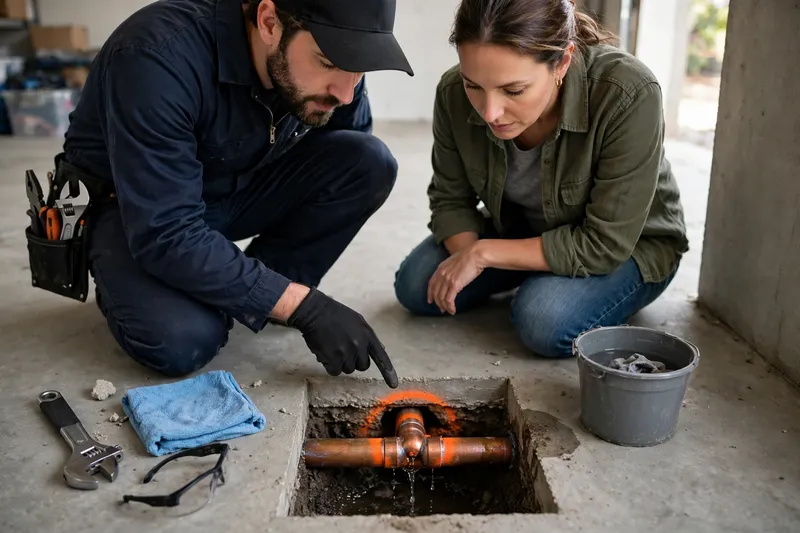
What It Costs to Find a Leak Under a Concrete Slab in Camden, NJ
Straight numbers, nationally published: Angi's 2026 cost data puts slab leak detection at an average of $280, with most homeowners paying $150–$400 — emergency calls land toward the higher end. Those are national ranges, not a Camden price list; every home's layout changes the work. What we can tell you plainly about slab leak detection pricing: a slab-leak visit runs 2–4 hours, longer than a simple leak call, because the equipment has to scan a larger area through concrete and we run multiple technologies in sequence. Our visits are priced upfront before we start — you'll know the number before we unpack a single sensor.
Repair Options Once We've Found It
We detect; we don't repair — but you shouldn't walk into a plumber's quote blind. Here's how the options compare once slab leak detection has pinpointed the break, with published cost ranges:
| Option | Typical range | When it makes sense |
|---|---|---|
| Spot repair — open the slab, fix the section | $630–$4,000 | Single leak, otherwise sound plumbing, accessible location |
| Tunneling — dig under from outside | $200–$500 per linear foot; often $3,000–$8,000 total | You're living in the home, expensive flooring to protect; no jackhammers or dirt inside |
| Reroute — abandon the line, run new overhead | $1,200–$2,800 partial; $3,500–$7,500 full | One bad line, rest of system sound; avoids the slab entirely |
| Full repipe — new PEX or copper through attic/walls | $7,600–$15,800 | 1970s–90s copper failing as a generation; second leak appears |
| Epoxy lining — coat the pipe interior | $80–$250 per linear foot | Niche option for supply lines; seals pinholes without opening the slab |
The decision math, from cost analysts: pay for the first slab-leak repair, and start pricing a repipe the moment there's a second — two tunnel jobs plus two detection visits can total $4,000–$11,500, which is repipe money spent without getting new pipes. And a word of caution from a homeowner forum: one neighbor got a verbal "$500–$1,500" quote for a hot-water slab leak repair and was charged $1,500 for what turned out to be a reroute. Get it in writing — and get the slab leak detection report first, so every quote is for the same marked spot. As for accuracy: acoustic plus tracer gas typically pinpoints within 6–12 inches — that's what keeps a tunnel short and a spot repair small.
Will Insurance Cover a Slab Leak?
The rule that decides every claim: homeowners insurance responds to sudden, accidental damage — not to replacing an aging pipe under a foundation. It may cover the resulting water damage, but your policy wording controls. One homeowner's documented story shows how it plays out: after confirming a slab leak, they hired a slab leak detection company mainly to file the insurance claim — the detector's sonar found two leaks under the slab. Two adjusters came out, and the insurer concluded repiping was most cost-effective: they wouldn't pay for the pipe repair itself, but they covered the plumbers' labor and the resulting damage — plaster, texture, primer, paint. Warning that matters: if detection reveals long-term damage — established mold, deep saturation — a carrier may treat it as gradual and deny. Talk to your plumber about what the findings show before you file.
What a Slab Leak Does If You Ignore It
- It eats the ground under your home. Escaping water washes away the sandy South Jersey soil your slab sits on — leading to voids, settling, cracking, and uneven floors. Foundation work dwarfs the cost of finding a leak early.
- It feeds hidden mold. Moisture wicks up through the slab into flooring and baseboards — and our humid Jersey summers turn that dampness into mold fast, where you won't spot it until it's established.
- Your meter never stops. Every leaking gallon shows up on your bill — month after month, you're paying for water that's undermining your foundation.
- Small leak, small fix. A leak we pinpoint this week is a contained repair; the same leak months from now is a much bigger job.
How Our Visit Goes
First, we talk and test. You describe the symptoms — warm floor, high bill, sounds — then we run a meter test to confirm the leak before our slab leak detection equipment comes out. Then we isolate. Hot and cold lines get shut off one at a time to identify the losing run, cutting the search area way down. Then we trace. Microphones, thermal camera, and tracer gas when needed follow the sound and heat across your slab to the source — confirmed with two methods before we mark anything. Then we mark it. The exact spot gets marked on your floor, plus a written report your plumber can work from directly. No exploratory jackhammering.
We work Parkside, Whitman Park, Cramer Hill, Fairview, Bergen Square, and across Camden County — slab-built ranches, aging copper and galvanized lines, freeze-thaw winters punishing buried pipe. That local knowledge is half the diagnosis. Call (856) 245-0967 for slab leak detection in Camden — we'll get your inspection booked.
Slab Leak Detection FAQs for Camden Homeowners
No — that's the whole point of slab leak detection. Our microphones hear the leak through concrete; the thermal camera sees hot-line heat through flooring. We mark the spot without opening anything — breaking happens later, in one small area, when your plumber repairs it.
Most folks describe it as a faint rushing or hissing under the floor when everything's off — like a toilet running somewhere else in the house, or water trickling inside a wall. Our equipment hears it far better than ears can, which is how we trace it to the source. Late at night, when the house is quiet, is when homeowners notice it first.
It can. Water under pressure erodes the soil beneath your slab a little more every day — and South Jersey's sandy soil washes away easily. As soil leaves, sections of slab settle and crack, while moisture wicking upward ruins flooring and grows mold along the way. Early detection keeps it a plumbing fix instead of a foundation project.
Most slab leak detection visits run 2–4 hours — longer than a simple leak call, because the equipment has to scan a larger area through concrete and we run multiple technologies in sequence. You'll know where the leak is before we leave.
If water's actively flooding or pressure has collapsed, shut the main valve. For the usual signs — warm floors, high bills, faint sounds — leave it on so we can trace the active leak. Not sure? Call (856) 245-0967.
Detection is our specialty. We pinpoint the leak and document it in a written report, and your plumber uses that to make a precise, minimal repair. That division of labor is exactly what keeps your costs down — no exploratory demolition billed by the hour. A master plumber on the Terry Love forum advises the same split: hire a dedicated leak detection company, not a plumber who merely advertises it.
With acoustic plus tracer gas confirmation, slab leak detection with acoustic plus tracer gas confirmation typically lands within 6–12 inches. That accuracy is what keeps a tunnel short, a spot repair small, and your flooring intact everywhere else.
If it's your first leak and the rest of the system is sound, detection plus a targeted repair is the economical move. But if it's the second leak — or the house is 70+ years old with original copper — price the repipe. One veteran plumber's rule: on a house that old, save your detection money and repipe. We'll tell you honestly which situation you're in.