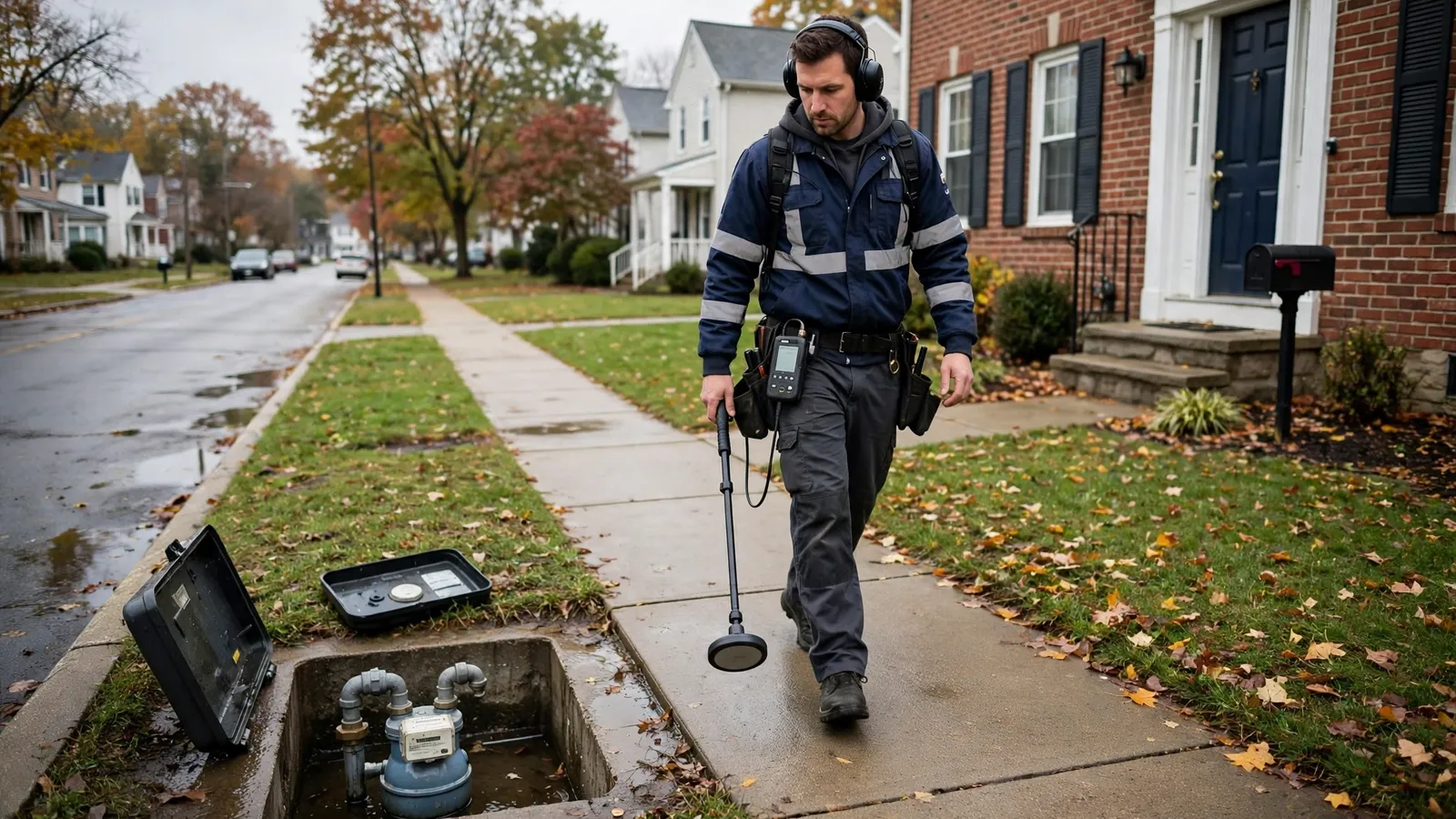
Here's the straight answer: when the pipe from your meter to your house springs a leak, the water vanishes into the dirt — and all you see is the bill. Underground main line detection is how we find it without trenching your whole yard: we prove the leak is outside with a meter test, trace the line's actual route, and listen along its length until the sound peaks at the break. One more thing Camden homeowners should know up front: with nearly 63% of Camden homes built before 1950, the pipe under your yard is very likely old galvanized or even lead — and a 2021 New Jersey law has the water utility replacing those lines at their expense through 2031. So the first question isn't always "where's the leak" — sometimes it's "who pays." Call (856) 245-0967 and we'll sort out both.
Signs You Need Underground Leak Detection: A Spinning Meter & a Soggy Patch
You can't see the pipe, so you read the clues it leaves behind — and every one of them is a reason to call for underground main line detection before the ground damage spreads:
- The meter moves with everything off. The big one — the most reliable sign there is. Close your house main valve: if the meter's leak indicator still creeps, the leak is in the buried stretch between meter and home.
- A bill that jumps with no change in usage. Thousands of gallons can disappear between readings.
- A soggy, sunken, or weirdly lush patch that stays green through dry spells — one strip of lawn getting watered from below.
- Water pooling or bubbling up in the yard, along the driveway, or near the curb.
- Pressure dropping — especially cold. Low cold pressure while hot stays normal points to the service line, before the water-heater split.
- Hissing at the meter or in the yard at night, when ambient noise drops.
- Walkways or driveway sections settling over the buried line's path.
Two field stories worth knowing. A veteran on the Terry Love plumbing forum describes a main-line leak "bad enough to kill a tree, yet no visible water" — the water had followed a nearby gas-line trench bedded in sand, so nothing ever surfaced. Confirmed by cutting the main and pressure-testing. No puddle doesn't mean no leak. And here's a pro's DIY pinpoint tip from the same forum: walk the likely meter-to-house path pressing an aluminum arrow 18 inches into the ground every foot — where it pushes "much easier… the arrow will be wet and it's possible water will start coming up out of the hole." Try it if you're curious; then call us for underground main line detection to mark it precisely.
What Fails Down There: Camden-Era Pipe Materials
What's buried under Camden yards depends on when the house went up — and with 63% pre-1950, it's usually the old stuff. Knowing the material shapes every underground main line detection visit we run:
- Galvanized steel. The Camden-era default. It corrodes from the inside; mineral deposits narrow the bore and strangle flow. A home inspector's standard write-up: old galvanized service pipe has "an unpredictable remaining lifespan and should be considered as fully depreciated." Translation: one leak means the rest has thinned too.
- Lead. Still in the ground under pre-1950 homes. Here's the twist that changes everything: New Jersey's 2021 law — signed by Governor Murphy — requires every water provider to replace both utility-owned and customer-owned lead and galvanized service lines by 2031. NJ American Water, headquartered right here in Camden, had replaced roughly 10,000 customer-owned lines by late 2024, and Camden is one of ten NJ communities in the EPA's lead-line replacement accelerator. If your line is lead or galvanized, the utility may replace it at their expense — check your line material at the utility's lead-facts page before you pay for anything. That's why the first step of any underground main line detection call in Camden is identifying the pipe material.
- Copper. Roughly a 50-year lifespan; pinhole leaks from aggressive water chemistry and external soil corrosion.
- Polybutylene. Grey plastic used from the mid-70s to mid-90s; it turns brittle and cracks — plumbers report failures starting at 22–30 years, accelerated by chlorine in treated water.
Where they fail: joints and fittings first. Mixed-metal joints without dielectric unions corrode fast from electrolysis. Tree roots hunt joints. Freeze-thaw heaves the ground. And a bed of sand under the pipe — the right way to lay one, per a Massachusetts-licensed journeyman plumber — protects against impact and corrosion; many old Camden lines never got it.
How Underground Water Line Leak Detection in Camden, NJ Traces the Route & Finds the Break
Direct answer: This is the core sequence of professional underground main line detection: meter test to prove the leak is outside → trace the line's actual route → pinpoint with acoustic equipment (and tracer gas when soil swallows sound). No blind trenching.
- We prove where it is. House main valve closed, watch the meter. Still spinning? The leak is in the underground stretch — not inside. It's the opening move of every underground main line detection job, and one test solves half the mystery.
- We map the real route. Service lines don't run straight — especially in Fairview and Whitman Park, where lines were laid generations ago. Ground microphones do double duty here: they amplify escaping-water noise and can trace the pipe's path by inducing a sound wave along it, measured at the surface.
- We listen. We walk the traced path with ground microphones until the signal peaks — that peak is the break, usually within a foot or two. For long runs, leak correlators place two sensors at fittings and compute the leak's position from the acoustic signal's arrival delay — utility-grade accuracy, no excavation.
- We run tracer gas on the tough ones. Deep burial, rocky fill, pavement — sometimes soil swallows sound. We charge the line with the industry-standard mix (95% nitrogen, 5% hydrogen — non-toxic, non-corrosive; hydrogen's tiny molecules permeate soil fast) and sweep the surface for where it escapes.
- We pressure-test sections on long meter-to-house runs, isolating segments and watching for pressure drop.
A veteran forum pro frames the economics every homeowner should hear: "If the meter still spins with everything turned off, you have a serious leak, likely the main supply line between the meter and the house… If it is the supply line, the major cost will be labor for doing the digging. Materials and the actual plumbing cost will not [be] that much." That's exactly why underground main line detection pays for itself — the digging is the expensive part, so you dig once, in the right spot.
Who Owns the Line — You or the Water Company?
The standard American split: the utility owns from the street main to the curb stop (or meter); you own from there to the house — and you pay for its repair. It varies by community, so verify with your provider. But New Jersey has the big exception: the 2021 lead law described above means NJ American Water is replacing customer-owned lead and galvanized lines at utility expense through 2031. Before you spend a dollar on a Camden service line, find out what your pipe is made of — you might be covered.
Underground Main Line Detection in Camden, NJ: What the Visit Covers
An underground visit is really four jobs wearing one coat. Here is what each one involves — and why the mark on your lawn has to be right before anyone digs.
Service Line Leak Location
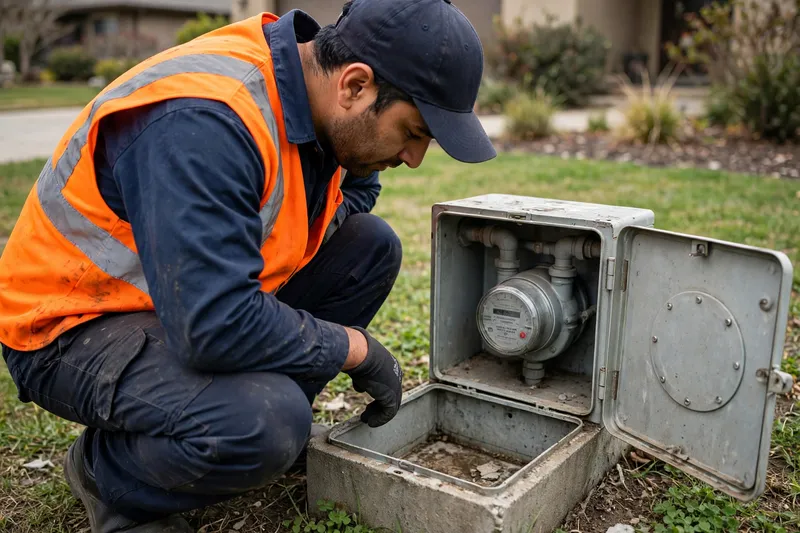
We start with the meter test: your house main valve closed, and if the meter’s leak indicator still creeps, the leak is in the buried stretch between meter and home. Then we listen along the line’s route with ground microphones until the sound peaks at the break — usually within a foot or two. No puddle doesn’t mean no leak; the meter settles it.
Line Route Tracing & Depth
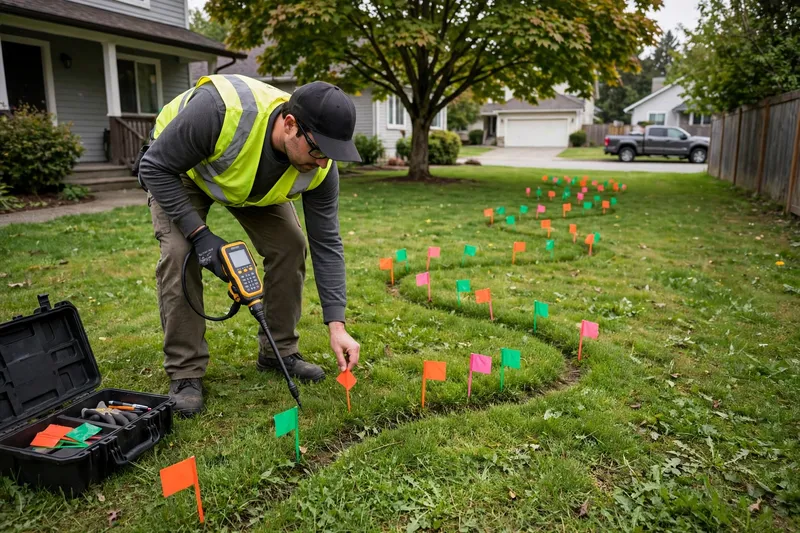
Service lines don’t run straight — especially in Fairview and Whitman Park, where lines were laid generations ago. Our ground microphones do double duty here: they amplify escaping-water noise and can trace the pipe’s actual path by inducing a sound wave along it, measured at the surface. We map the real route before anyone talks about digging.
Who-Owns-the-Line Evidence
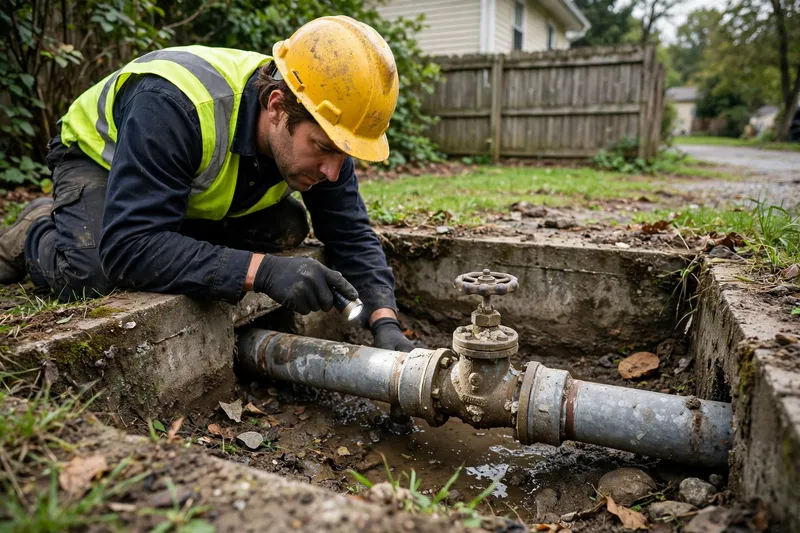
The standard split: the utility owns from the street main to the curb stop, and you own from there to the house. But New Jersey’s 2021 law has NJ American Water replacing customer-owned lead and galvanized lines at utility expense through 2031 — so our first job is identifying your pipe material. If it’s lead or galvanized, you may not be paying for any of this.
Pre-Dig Marking for Repair Crews
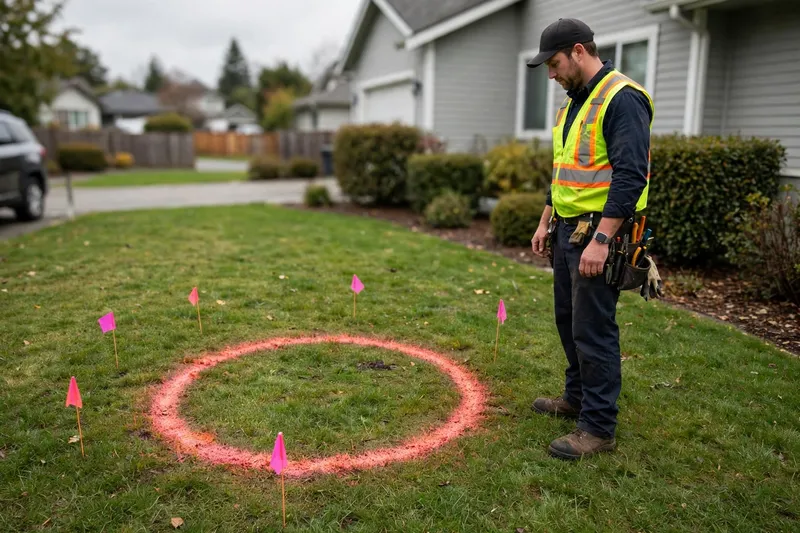
The digging is the expensive part, so the mark has to be right. We pinpoint the break, pressure-test sections on long meter-to-house runs to isolate the failing stretch, and hand your crew one marked spot. A repair dug once, in the right place, costs a fraction of a trench hunted across a finished yard.
What It Costs to Find a Buried Water Line Leak in Camden, NJ
Published 2026 numbers on underground main line detection and repair, national data — not a Camden price list:
| Work | Typical range | Notes |
|---|---|---|
| Leak detection (general) | $100–$500 | Angi 2026; underground exposure alone runs $500–$1,500 |
| Spot repair | $200–$600 | Licensed plumber's published rates; one shop notes spot repairs last ~5–10 years — "not a real fix" |
| Section replacement | $400–$1,200 | Targeted, when the rest of the line is sound |
| Full replacement, trenched | $1,500–$5,000 | Angi average $1,702; $50–$150 per linear foot; NY Tristate average $2,457 |
| Trenchless (pipe bursting) | $6,500–$14,500 | Minimal digging; driveway crossings add $850–$2,400 each |
The decision that matters: one homeowner with a 1911 house got a city order to fix a leaking line in 30 days — directional boring quoted $2,400–$3,500 (about 90% odds of success) versus open trench replacing water and sewer at $10,000–$12,000. Trenchless isn't always cheaper, but on a 90-foot run under a finished yard, the math changes fast. Permits and inspections typically add $150–$500.
Will Insurance Cover It?
Standard homeowners (HO-3) policies do not cover main-line failure — wear and tear, gradual deterioration, and ground movement are excluded, "which together account for nearly every way an exterior water line fails." The fix is the service line endorsement: an optional rider typically covering up to $10,000 per failure with around a $500 deductible, for roughly $20–$50 a year. The catch, via reinsurance analysts: homes 50+ years old may face a reduced limit around $2,500 unless the line was replaced in the last 50 years — "the homes most likely to need the coverage are exactly the ones that get the lowest limits." Don't confuse it with sewer-backup coverage, which pays for the mess inside the house, not the pipe itself.
What a Buried Leak Does While You Wait
- It hollows out the ground. Escaping water washes soil away underground — lawns sink, walkways crack, driveways settle. Fixing hardscape costs far more than finding a leak.
- It waters your wallet. Thousands of gallons vanish between meter readings, and every gallon is on your bill.
- It creeps toward your foundation. Saturated soil finds basements and crawl spaces — and with the Delaware River nearby, many Camden homes already battle groundwater.
- Winter hits harder. NJ freeze-thaw cycles punish pipes, and saturated ground around a leaking line is even more vulnerable when temperatures swing.
What a Visit Looks Like
We confirm it's underground. Every underground main line detection visit starts the same way: meter test, house valve closed — if the meter advances, the break is in the buried run. We trace the route. We map your service line's actual path from meter to house, because old lines wander. We listen and mark. Microphones and correlators along the traced path, following the sound to its peak — then we mark your dig point on the surface. You get it in writing. A report with the line route, marked location, and findings — your plumber goes straight to the break. One hole, one repair, done. Call (856) 245-0967 to get scheduled.
Underground Water Line Leak Detection FAQs for Camden Homeowners
The meter test settles it. Close your home's main shutoff valve and watch the meter — if it still moves, the leak is in the buried line between the meter and your house. If it stops, the problem's inside. We run this test at the start of every underground main line detection visit, so there's no guessing.
No — that's what we're here to prevent. We mark the break on the surface first, so digging happens in one small, targeted spot instead of blind trenching along the whole line. The digging is the expensive part of any main-line job, which is exactly why detection pays for itself.
Yes — our microphones listen through soil, concrete, and asphalt, working right on the surface above the line. Where pavement muffles sound, tracer gas gives a reading without lifting a paver, and correlators compute position from sensor data alone.
Possibly. New Jersey's 2021 law requires water providers to replace customer-owned lead and galvanized service lines by 2031 at the utility's expense — and NJ American Water, headquartered in Camden, is actively doing it. Find out what your pipe is made of before you pay for replacement; you might be covered.
If the rest of the line is sound (copper or plastic, one bad joint), a targeted repair makes sense. If it's galvanized — corroding from the inside along its whole length — one leak means the rest has thinned too, and replacement is the honest recommendation. A 1911-house homeowner faced $2,400–$3,500 for directional boring versus $10,000–$12,000 for open trench; the right answer depends on length, depth, and what's above it.
Standard policies don't — wear, gradual deterioration, and ground movement are excluded. The service line endorsement rider does: typically up to $10,000 per failure for roughly $20–$50 a year. Note the catch for older homes: houses 50+ years old may face reduced limits around $2,500 unless the line was replaced recently.
Quite possibly — a leaking line irrigates one unlucky patch. If it stays green and spongy through dry spells, especially with a higher bill, have us check it. One caution from the field: water can travel along a trench bed and surface far from the break, so the green patch marks the symptom, not necessarily the leak — that's what our equipment is for.
Give it to your plumber or excavation contractor. It shows the marked leak location and our findings, so they dig at the mark, fix or replace that section, and backfill. Straightforward — and if your line qualifies under the NJ lead-line program, the report documents what the utility needs to see.