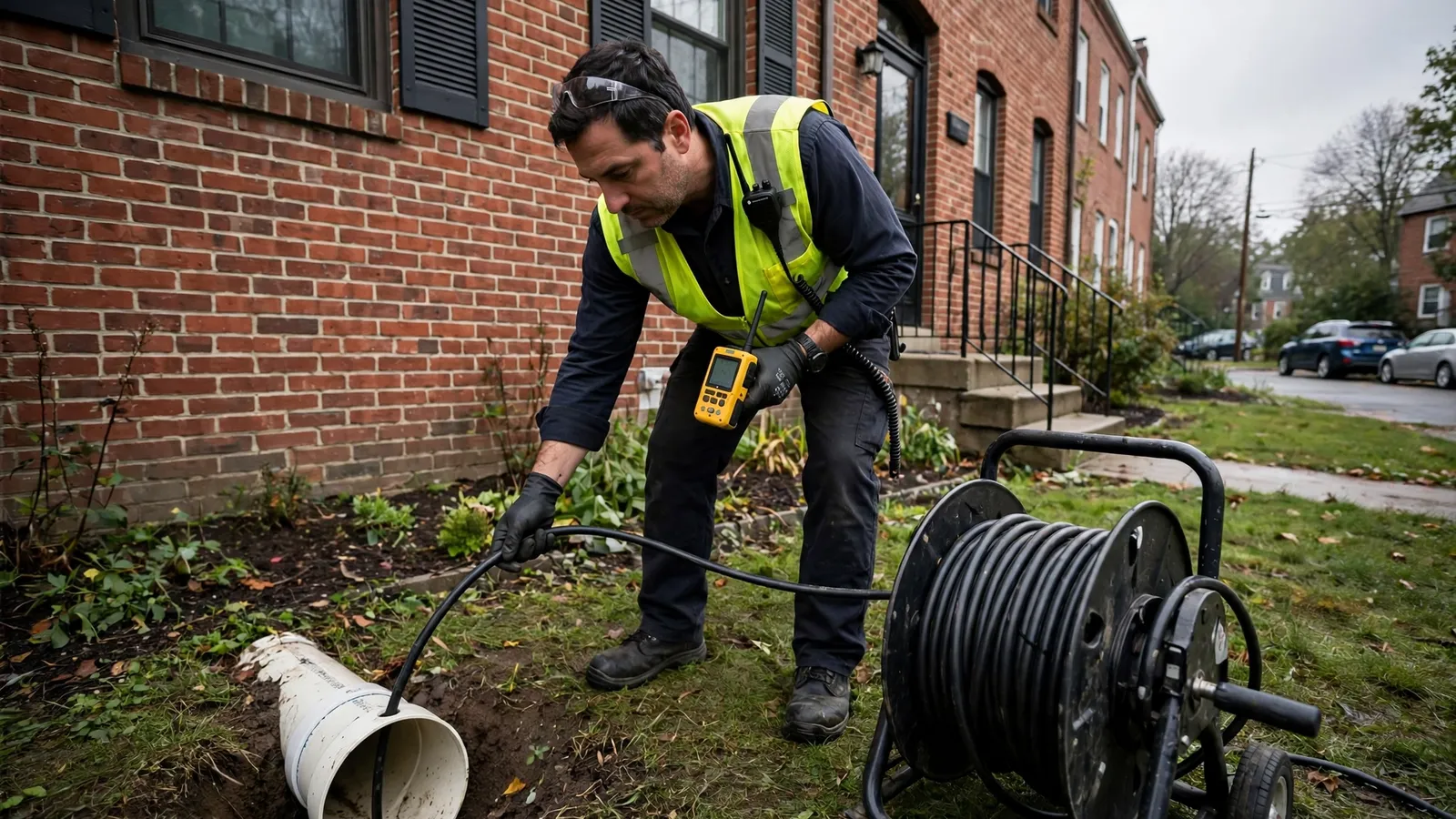
Nobody wants to think about their sewer line — until it makes them think about it. The smell in the yard. The soggy patch that never dries. Every drain in the house suddenly slow at once. Sewer line leak detection is how we find the break, crack, or root-choked joint without digging up your whole yard: a camera inside the pipe, a locator tracking it from above, and a mark on the ground where the problem is — position and depth. And here's the Camden part that matters: your lateral feeds into a municipal sewer system roughly 100 years old, much of it brick and clay combined sewers that surcharge in heavy rain. You may be fighting two problems, not one. Call (856) 245-0967 and we'll sort out which is yours.
Signs You Need Sewer Line Leak Detection: Slow Drains, Gurgling & a Soggy Lawn
Camden's laterals tell on themselves. Watch for:
- Sewage smells in the yard, the basement, or around drains — usually the first sign.
- A soggy or sunken patch in the lawn that never quite dries, often along the line's path to the street — or one patch of grass suddenly lusher than the rest. It's getting fertilized, unfortunately.
- Gurgling toilets or drains when water runs elsewhere in the house.
- Every drain slow at once. One slow drain is a clog; all of them is the main line talking.
- Sewage coming back up into tubs, showers, or floor drains.
- Cracks or settling near the foundation where the line exits — long-term washout undermines support.
- Backups that return after cleaning. A line that clogs again weeks after a cleanout isn't dirty — it's structurally damaged.
Two stories from the forums. A daycare center had three clogs in weeks at the city-connection end of its line; video inspection found roots growing where the building's PVC meets the city's clay pipe, a coupling separating mid-parking-lot, and a section holding water — a belly — running under the AC unit and water meter. The fix: replace about 75 feet from the building to the street, under two fences, an AC unit, and a freshly repaved parking lot. That's why you camera first. And a homeowner's dispute story: sewage backed up in February, emergency cleanout found tree roots — $600; two months later it happened again, and three plumbers confirmed structural root damage near the walkway cleanout with $5,000–$7,000 repair estimates. Recurring backup means structural problem — and it's the most common reason Camden homeowners call us for sewer line leak detection.
How a Sewer Camera Inspection in Camden, NJ Finds the Break Without Digging
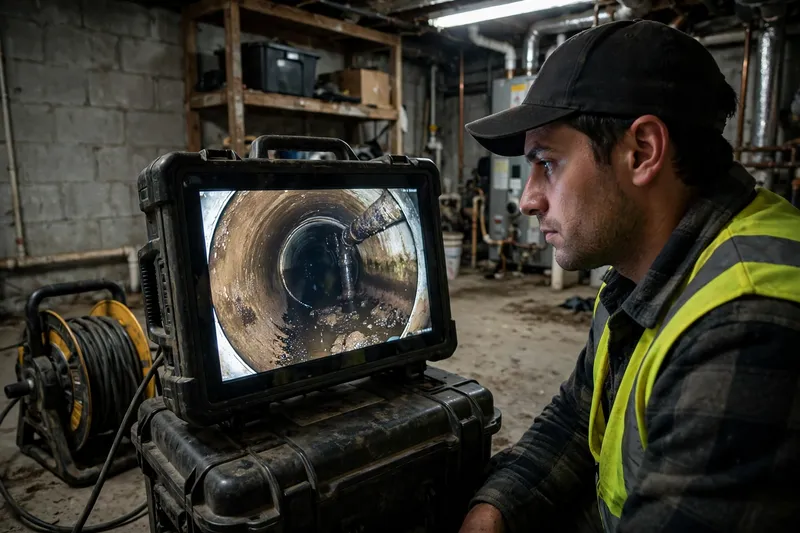
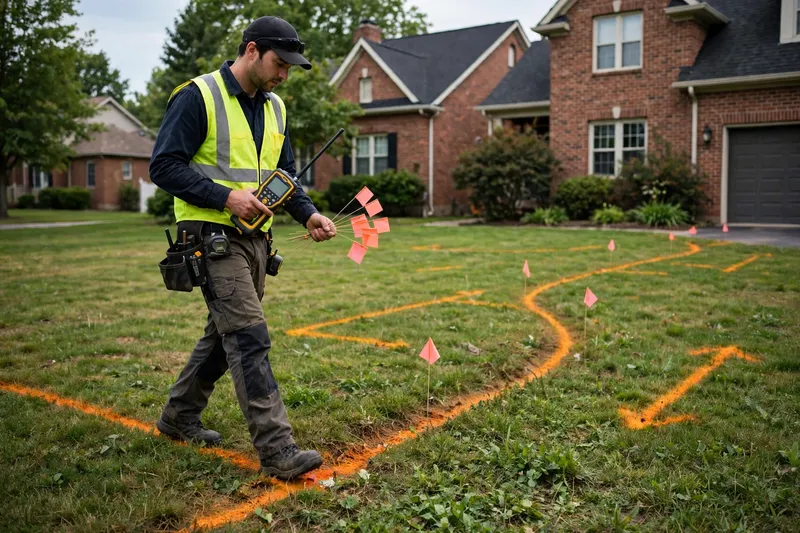
Sewer lines don't hold pressure — everything flows downhill by gravity — so the listening gear we use on supply lines doesn't apply here. Instead, we look directly. A waterproof camera on a flexible cable goes in through your cleanout (or a pulled toilet) and gets pushed downstream while we watch live color video: blockages, cracks, root masses, bellies, offsets, collapses — plus the pipe's material and diameter. The camera head carries a tiny radio transmitter (a sonde); our technician walks the yard with a receiver tracking its exact position and depth, foot by foot. When the video shows the defect, we mark that spot on the surface — position and depth, which your excavator will thank us for. A standard residential lateral typically takes under an hour for sewer line leak detection, and you should get a copy of the footage.
Direct answer: a camera documents only the visible interior of the sections it reaches — it does not measure remaining pipe-wall thickness, and standing water, heavy deposits, or no cleanout access can stop it. Any honest report says which sections it couldn't reach. Ask what access point was used, where the camera stopped, and which sections are which material.
Where cameras can't go, we have backups: smoke testing — non-toxic smoke blown into the drain system escapes through cracks, broken joints, and failed seals, sometimes surfacing through yard soil or pavement cracks; dye testing — tracing dye flushed through specific fixtures to confirm where they drain. As one pro put it about combining video with the surface locator: it lets you "pinpoint the location, where the camera gets stopped by the roots, so they would know where to dig." One marked spot, not a trench of guesses.
What Fails in Camden Laterals
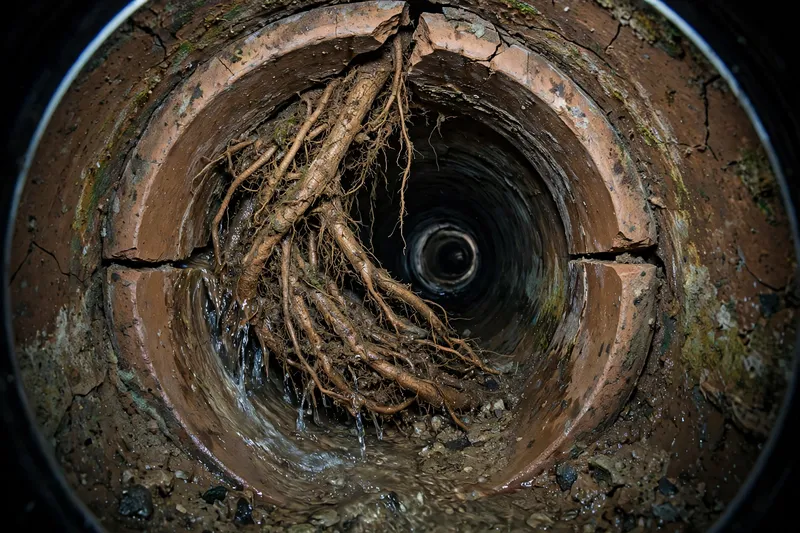
- Tree roots — the classic. Roots seek water; a small crack or loose joint is an invitation. They enter as fine hairlike strands, then thicken and catch paper and waste until the blockage grows. Clay and older jointed pipes are especially vulnerable.
- Cast iron corrodes inside out. Scaling, rust buildup, thinning walls, eventual collapse — the standard story in older homes.
- Clay pipe cracks and separates at joints as soil moves; every loosened joint invites roots.
- Orangeburg — tar-impregnated fiber pipe used in some mid-century homes — "never intended as a permanent solution." It deforms and largely disintegrates in the ground over time.
- Bellies (sags). A section sags from poor soil support or settling; wastewater slows in the low spot, solids settle, clogs repeat. Clearing helps briefly — the geometry remains.
- Offsets. Sections shift out of alignment from soil movement or freeze-thaw; waste catches on the offset and it worsens gradually. A camera shows this clearly.
- Grease. Goes down warm and liquid, cools and clings — with soap, food, and paper it forms a sticky narrowing.
Material eras: homes built before the 1980s commonly have clay, cast iron, or Orangeburg; modern replacements are PVC/ABS, resistant to corrosion and roots. With 63% of Camden homes built before 1950, clay and cast-iron laterals are the expectation here, not the exception — and "flushable" wipes snagging on root intrusions can trigger sudden backups on top of it all.
Camden's 100-Year-Old Combined Sewers
Your lateral is only half the story. Camden's municipal sewer system is roughly a century old and combined — about 180 miles of it, with 22 city-owned overflows plus a county one. A 2009 infrastructure assessment found the majority of main structures are brick, with minor arteries of vitrified clay or reinforced concrete — and between 1877 and 1918, one contractor built 30+ miles of brick and clay sewers here; nearly 50 miles existed by 1900. What that means for you: during heavy rainfall, the combined system surcharges — resident reports from the assessment confirm "stormwater and sanitary sewer spews from cleanouts." Recent data shows the system discharging raw sewage dozens of days a year. So if your backup coincides with heavy rain, part of the problem may be municipal surcharge, not just your lateral. A sewer line leak detection camera inspection answers the lateral half definitively; the combined-system half is the city's — and knowing which is which changes who you call.
Sewer Line Leak Detection in Camden, NJ: What the Camera Visit Covers
A camera visit is really four jobs wearing one coat. Here is what each one involves — and why skipping any of them is how yards get dug up in the wrong place.
Sewer Camera Inspection
We push a waterproof camera on a flexible cable in through your cleanout — or a pulled toilet — and watch live color video as it travels the lateral: blockages, cracks, root masses, bellies, offsets, collapses, plus the pipe’s material and diameter. You get a copy of the footage, and our report says plainly which sections the camera couldn’t reach.
Lateral Locating & Depth Marking
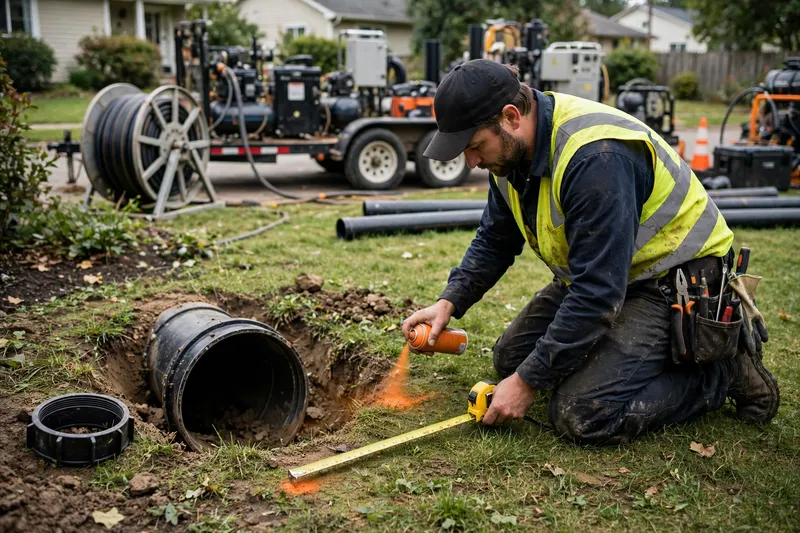
The camera head carries a sonde — a tiny radio transmitter — and our technician walks your yard with a receiver, tracking its exact position and depth foot by foot. When the video shows the defect, we mark that spot on the surface. One marked spot, not a trench of guesses — and your excavator will thank us for the depth.
Root Intrusion & Offset Joints
Roots are the classic Camden failure: they slip into clay and older jointed pipe as fine hairlike strands, then thicken and catch paper and waste until the blockage grows. The camera also shows offsets — sections shifted out of alignment by soil movement and freeze-thaw — where waste snags and the backup keeps returning weeks after every cleaning.
Trenchless Repair Suitability Checks
Whether lining or pipe bursting fits depends on the pipe’s shape and condition: lining needs a pipe that still holds its shape, bursting fits one that’s too far gone, and a collapsed section may still need open excavation. Since we don’t sell repairs, our assessment has no upsell in it — just the camera facts, with the location and depth a contractor needs to quote either method honestly.
What It Costs to Camera a Sewer Lateral in Camden, NJ
Published 2026 numbers on sewer line leak detection and repair. Camera inspection: basic visual $150–$300; HD with recording and report $300–$600; specialty (360°, self-leveling) $600–$1,500+. By length: under 50 ft $175–$250; 50–100 ft $250–$400; over 100 ft $400–$800. Closest market proxy, Philadelphia: $286–$785, averaging about $503. Repairs: digging and replacing $50–$250 per linear foot; trenchless $60–$250/ft; CIPP lining $80–$250/ft; pipe bursting $60–$200/ft. Overall sewer repairs $1,100–$4,100; full replacement typically $3,000–$12,000; hydro jetting (clearing, not repair) $350–$600. Real quoted numbers: 29 feet of CIPP lining at $11,755 and 46 feet at $13,370 — itemized, root removal and all. Those are national and regional figures, not Camden prices — but they frame every quote you'll get.
Trenchless Repair: What It Is, When It Fits, When It Doesn't
Two trenchless methods exist. CIPP lining ($80–$250/ft) installs a resin liner inside the old pipe; pipe bursting ($60–$200/ft) pulls a brand-new HDPE line (40–50+ year life) through the old pipe's path. Lining fits when the pipe still holds its shape; bursting fits when it's too far gone. Collapsed sections may still need open excavation — and lining a badly compromised pipe can mean paying twice within years. Either way, the contractor needs our camera report — exact location and depth — to quote either method honestly. Since we don't sell repairs, our assessment has no upsell in it — just the facts, which puts you in the strongest spot collecting quotes.
Will Insurance Cover It?
Standard HO-3 policies explicitly exclude water or sewage that "backs up through sewers and drains." The sewer backup endorsement is the fix: typically $50–$250 a year for $5,000–$25,000 of coverage — it pays for interior damage and cleanup, not the sewer line itself. Note the gap: average sewage cleanup runs $10,000–$20,000, above many endorsement caps. A separate service line endorsement covers the lateral pipe itself, but few insurers offer it — you may need to switch carriers. And wear and tear is never covered: no maintenance history or documented root damage can both be denial grounds. The lateral on your property is your responsibility.
Sewage Backing Up Right Now?
Stop using water immediately. If sewage is coming up through a floor drain, toilet, shower, or tub, stop running water anywhere in the house — every flush and shower feeds the backup. Then call (856) 245-0967 for emergency sewer line leak detection; active backups jump our schedule. Know what you're dealing with: sewage is Category 3 "black water," the most contaminated classification — always treated as contaminated even when it looks diluted. Porous materials that absorbed it (carpet, padding, drywall, insulation) get removed, not dried. Don't DIY this one.
Sewer Line Leak Detection FAQs for Camden Homeowners
No — that's the beauty of sewer line leak detection. Camera and locator work entirely through existing access points — a cleanout, a pulled toilet, a floor drain. Digging only comes later, if you decide to repair, and then only at our marked spot, at our marked depth.
The camera's transmitter broadcasts from inside the pipe at the defect; our surface receiver pinpoints that signal and reads its depth. We mark position and depth on the ground and write it into your report for the contractor.
We usually get in anyway — a pulled toilet or a basement floor drain works. A proper cleanout makes everything faster, and it's worth adding one if you don't have it, but its absence won't stop a sewer line leak detection visit.
It documents the visible interior of the sections it reaches — not remaining wall thickness. Standing water in a belly, heavy deposits, offsets, or no access can stop it. Our report says which sections we couldn't reach and why; any report that doesn't is leaving something out.
Possibly both. Camden's combined sewers surcharge in heavy rain — residents have reported sewage spewing from cleanouts during storms. A camera inspection tells you definitively whether your lateral is compromised; if it's sound and backups track rainfall, the problem is municipal surcharge. Knowing which changes who you call.
It depends on what the camera shows. Lining and bursting avoid open trench and run $60–$250 per foot; but collapsed sections may still need excavation, and lining a too-far-gone pipe can mean paying twice within years — bursting installs a new 40–50+ year HDPE line instead. Our footage gives contractors what they need to quote both honestly.
Standard policies exclude sewer backup — the endorsement ($50–$250/year, usually $5,000–$25,000 in coverage) pays for interior damage and cleanup, not the pipe itself. A separate service-line endorsement covers the lateral, but few insurers offer it. Wear and tear is never covered.
Most Camden homes take one to two hours, including surface tracing and marking. Longer runs or heavy root intrusion add some time. You'll watch the monitor with us — no surprises later.