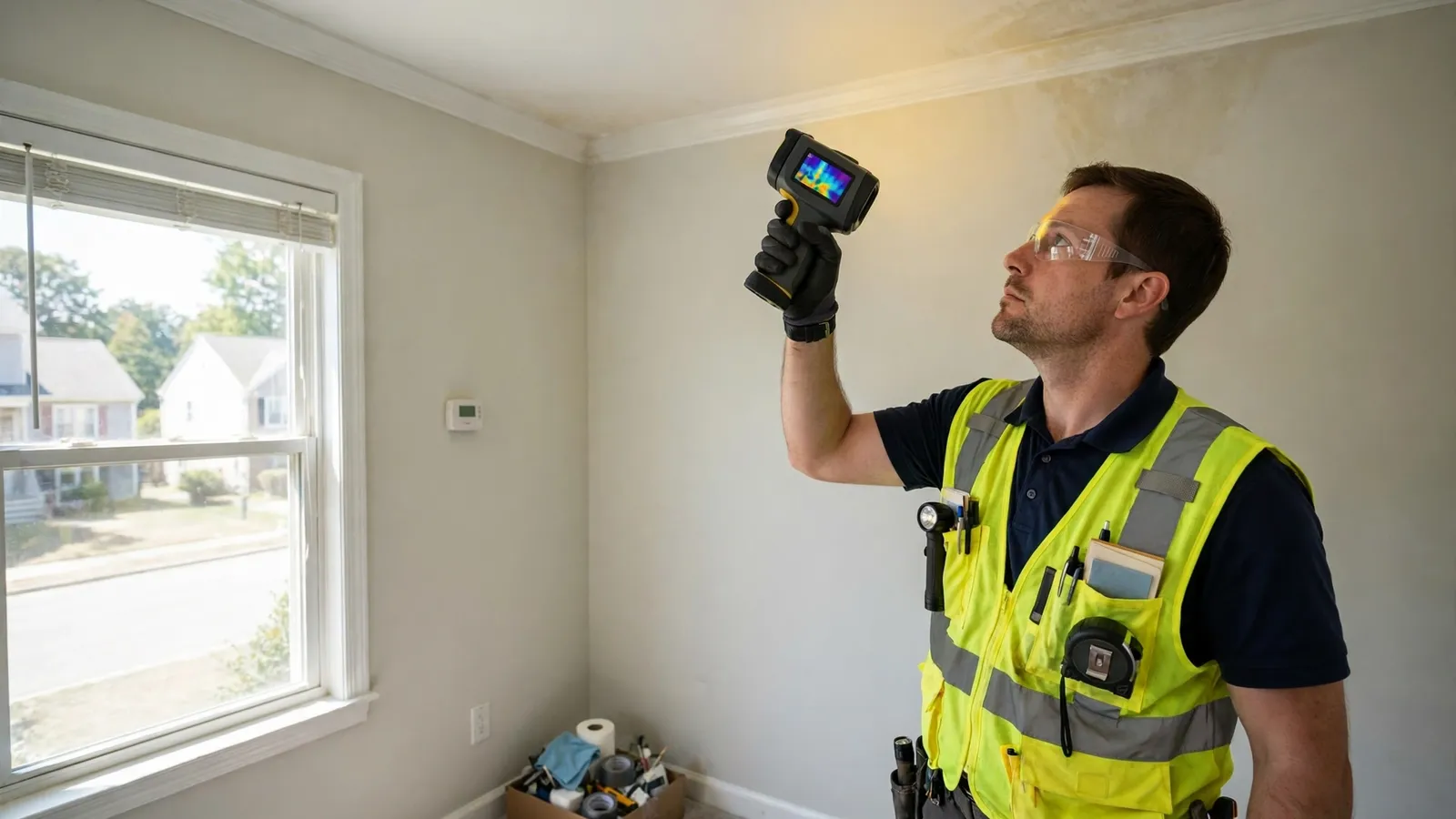
A stain spreading across the ceiling, paint bubbling for no reason, a musty smell you can't place — that's usually water traveling where you can't see it: inside walls, above ceilings, behind tile. Interior wall leak detection is how we find it without tearing your walls open: thermal imaging to reveal the hidden moisture pattern, professional moisture meters to confirm it, and a full moisture map traced back to the source — so the repair opens one precise spot, not half the room. One rule to remember before anything else: the stain is almost never where the leak is. Water travels. Call (856) 245-0967 before hidden moisture turns visible.
Signs You Need Interior Wall Leak Detection: Stains, Bubbling Paint & a Musty Smell
Water inside a wall cavity doesn't show itself directly — it leaves hints. Here's what to watch for, and how to read each one:
- Stains that keep growing — round stain: a small drip pooling above; long streak: water traveling along a joist or pipe; paint bubbles: moisture trapped behind the surface.
- Paint bubbling, peeling, wallpaper lifting at the edges.
- Musty, earthy smell with no visible mold — "one of the most reliable indicators of hidden wall mold after a water event." Interior cavities can stay wet for days or weeks after the surface looks dry.
- Drywall soft or spongy under light pressure — it's been wet long enough to lose strength.
- Baseboards warping or pulling away from the wall.
- Dripping or trickling sounds inside walls, often after water runs elsewhere.
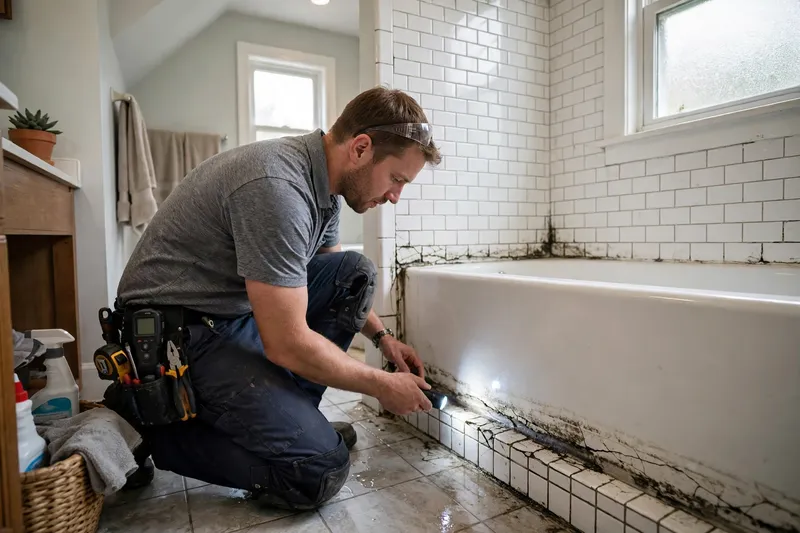
Bathrooms, kitchens, and laundry rooms are where most are found — supply lines, drains, and shower valves live behind those walls. And a leak-investigation firm that handles water-damage claims daily ranks the sources: plumbing pipes first, roof issues second, showers third — "showers cause more hidden water damage than almost anything else in a house. Once grout cracks or sealant pulls away, water sneaks downward and quietly eats into subfloors, joists, and ceilings." Then appliances and condensation. That's why interior wall leak detection starts with the timing question, not the stain.
The Stain Is Almost Never Where the Leak Is
Direct answer: the stain may sit six feet, ten feet, or an entire room away from the failed pipe. Water runs along framing, pipes, and ducts before it becomes visible — so patching the stain without tracing the source just buys time.
Two documented cases. On a plumbing forum, a homeowner's basement ceiling stain sat at the far west side of the house — he traced it to a gas-pipe penetration about 15 feet away, where shifted putty around the pipe let water in. Fifteen feet of travel along a single penetration. And a New Jersey contractor describes the chimney-flashing version: once water gets past failed flashing, "it doesn't drip straight down through your ceiling. It runs down the inside of your wall cavity, traveling along studs and insulation until it finds the path of least resistance. That might be 6 feet away from your chimney." That's why interior wall leak detection starts with mapping, not cutting — the wet spot is a symptom, and the cause might be a joint three stud bays over.
How Interior Wall Leak Detection in Camden, NJ Finds the Source Without Opening Walls
The pro sequence for interior wall leak detection, from trade sources:
- Thermal imaging first. Wet material holds temperature differently than dry — we sweep walls and ceilings with infrared, and hidden dampness shows as cool patterns (building research visualizes leaks at temperature gradients around 0.4–1.5°C). We scan slowly — moving fast hides subtle patterns — establish contrast against adjacent dry material, and trace the pattern's shape to see how moisture moved. Honest caveat: a thermal camera does not see through walls; it reads surface temperature only. Small leaks, cold-water leaks, and heavily insulated pipework produce little contrast.
- Pinless meter to scan, pin meter to confirm. Pinless (non-invasive) sweeps large areas fast without damage; pin-type then gives a precise reading at the suspect spot. On drywall: 5–10% moisture is normal, 10–15% suggests residual moisture, above 15% is abnormally high and likely an ongoing problem. Because meters are calibrated for wood, we compare against a known-dry spot of the same material — a different wall in the same house.
- Full moisture mapping. "Even if the outside looks normal, the inside of the wall may be wet. Moisture mapping is essential to understand the full extent of the damage." We read across the whole area — the visible stain is almost never the whole story.
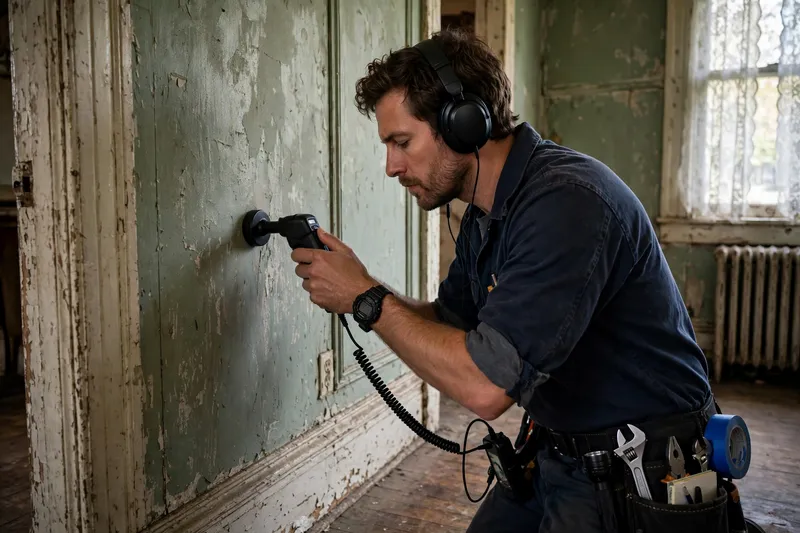
- Acoustic for supply lines in walls. Pressurized supply leaks hiss; sensors amplify the vibration. Paired with infrared, techs "pinpoint the leak and open only the exact location needed."
A veteran forum plumber with 32,000+ posts puts it plainly: "A slow leak or drip can run down a pipe quite a ways before it hits something that causes it to drip off… A moisture meter helps to determine if a wall or ceiling is damp." The camera narrows; the meter verifies; the map guides the repair — that's interior wall leak detection done right.
Where the Water Usually Comes From
Use the timing — it's the first question in interior wall leak detection:
- Stain appears or expands during heavy rain → roof: failed flashing around chimneys and valleys, cracked rubber boots on plumbing vent pipes ("a very common culprit"), clogged gutters backing water under edges, skylight flashing.
- Water after showering or flushing → drain or fixture leak: toilet seals, tub/shower drains, shower valves, failed caulking.
- Stain below an upstairs bathroom → plumbing supply or drain lines.
- Brown ring around a ceiling AC vent → condensate: clogged drain line, rusted pan, poorly sloped line.
- Stain growing in dry weather → plumbing, HVAC, or residual trapped moisture — not the roof.
- Damp wall or puddle near the water heater → tank, relief valve, or supply connection — water heater leaks often show up in the wall or floor beside the unit, not under it.
NRCA notes roof repairs commonly fail because nobody verified the leakage path first — penetrations and flashings deserve attention early, before anyone re-shingles over an active leak.
Why Camden Homes Need Leak Detection Inside Their Walls: Galvanized Risers & Cast Iron Stacks
In Camden's older rowhomes and twins, walls hide the original pipe runs — and three failure modes show up again and again in our wall scans:
Galvanized risers. The vertical supply lines running between floors in older twins are usually galvanized steel. They corrode from the inside, narrowing until pressure drops on the upper floor — and the first sign is often a damp patch on the ceiling below a bathroom, not a visible burst. One leak in a galvanized riser usually means the rest of the run has thinned too.
Pinhole leaks in copper. Copper lasts decades, but aggressive water chemistry and soil-side corrosion eat pinholes at solder joints — tiny holes that spray a fine mist inside the wall cavity. The stain appears feet away from the joint, sometimes a room away, because the mist follows framing before it drips.
Cast iron stacks behind plaster. The vertical drain stacks in pre-war homes are cast iron, and they crack in hairlines behind plaster and original tile. A stack crack doesn't gush — it weeps, feeding a musty smell and a stain that grows slowly. Thermal imaging finds the cool, damp track; the moisture map shows how far it spread.
Narrow chases and original tile make these leaks hard to open up blind — which is exactly why we map first. The camera and meters tell us which run failed before anyone touches plaster.
NJ Winters: Ice Dams
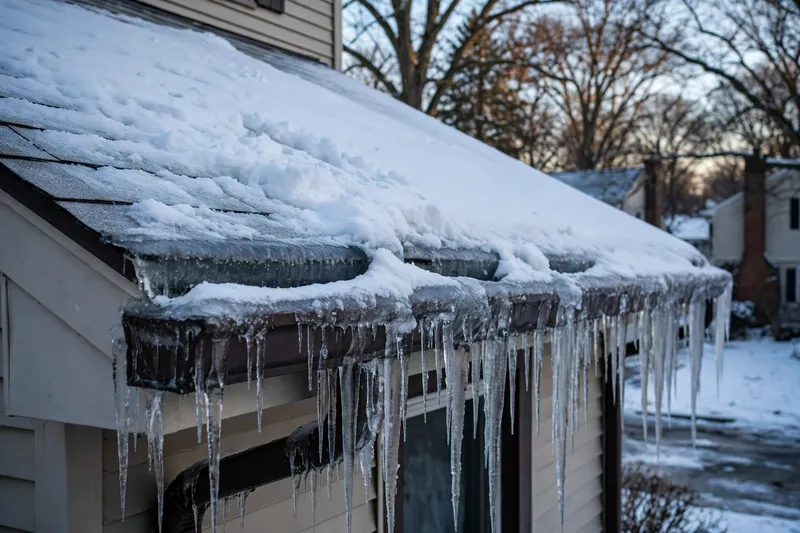
After a heavy-snow January, NJ contractors flag ice dams as a top post-storm threat: heat escaping from the attic melts roof snow, meltwater refreezes at the colder eaves, and the resulting ridge traps water "under your shingles and into your attic." Signs: icicles at gutters, ceiling and wall stains after a thaw, uneven roof melt. A South Jersey case: after a late-winter thaw, a homeowner found water stains spreading across upstairs ceilings — an ice dam had forced water under shingles, soaking attic insulation and rotting roof sheathing. Repair meant new sheathing, reinsulation, and ice-and-water shield: thousands of dollars, described as preventable. And NJ freeze-thaw "brutally" kills flashing seals — "water gets in, freezes, expands, and cracks the seal" — creating the gap that later admits winter moisture. If your ceiling stains appear every late winter, start with the roof, not the plumbing — though our interior wall leak detection maps the damage either way.
The 48-Hour Mold Clock
EPA, CDC, and FEMA cite the same window: mold growth begins within 24 to 48 hours of water exposure if the area stays wet — and if a home couldn't be dried in that timeframe, assume mold may be present even where it's not visible. Drywall is the perfect medium: porous gypsum holds moisture deep in its core, and a surface that feels dry can still hold 20–30% moisture internally — more than enough to sustain active mold. Missing the 48-hour window turns a drying job into a removal job: drywall gets cut out, insulation stripped. One industry piece frames a $3,000 drying job ballooning toward $15,000–$30,000+ once mold establishes — treat the upper figure as illustrative, but the mechanism is real. That's the cost of "let's watch it for a while" — and the reason interior wall leak detection exists.
What Interior Wall & Ceiling Leak Detection in Camden, NJ Covers, Job by Job
Finding the source without opening the wall is four jobs wearing one coat. Here is what each one involves — and why the stain alone never tells you where to cut.
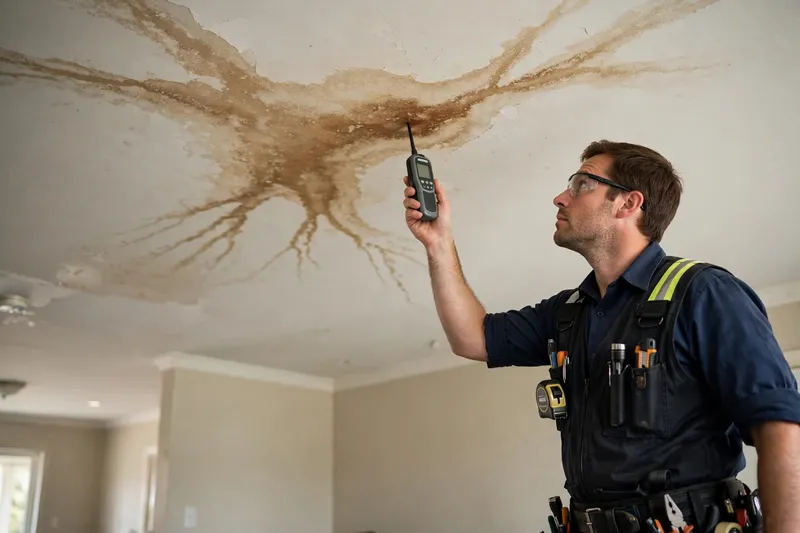
Ceiling Stain Source Tracing
A ceiling stain is a symptom, not an address — the water may have traveled six feet, or fifteen, along a joist or a pipe before it showed. We read the moisture gradient with thermal imaging and meters, following the damp back uphill until the pattern points at the pipe, flashing, or fitting that actually failed.
In-Wall Supply Line Leaks
Pressurized supply lines announce themselves if you know how to listen — a hiss inside the wall that acoustic sensors amplify and pinpoint. In Camden’s older twins that usually means a galvanized riser thinning from the inside, or a pinhole at a copper solder joint misting into the cavity long before a stain appears.
Upstairs Bathroom & Shower Leaks
Showers cause more hidden water damage than almost anything else in a house — cracked grout and failed sealant let water sneak down into subfloors, joists, and the ceiling below. We work from the timing — does the stain grow after showers and flushes? — and moisture-map the room until a drain, valve, or supply line separates itself from the rest.
Ice-Dam Water Tracing
When ceiling stains arrive every late winter, the source is often at the eave, not in a pipe: an ice dam forces meltwater under the shingles and down inside the wall cavity. We map the wet insulation and framing from inside, so the repair targets the entry path — not just the stain it left behind.
What It Costs
Published 2026 numbers, national — not Camden prices: most plumbers charge a flat service fee around $150 to diagnose a leak; a full home plumbing inspection averages $200. After detection, drywall repair runs $50–$75 per square foot — a typical pipe-leak drywall job $250–$750, a full ceiling repair $320–$1,300. If mold is present, average remediation is about $2,300, and "costs climb significantly" from there. Interior wall leak detection is the cheapest part of every one of those scenarios — it's what keeps a $300 diagnosis from becoming a $3,000 rebuild.
Will Insurance Cover It?
Sudden versus gradual governs interior leaks too. A burst pipe behind a wall, or an ice dam forcing water in during a storm — sudden and accidental, generally covered. A drip seeping behind a wall for weeks or months — gradual, generally excluded as maintenance. The trap to know: the "you should have known" rule. If a living-room ceiling showed a brown stain slowly growing over two months before it collapsed, the insurer will likely deny — "the visible stain was your warning to investigate and mitigate." Duty-to-mitigate clauses can sink the entire claim, not just post-discovery damage. Adjusters tap drywall, check for baseboard swelling, and look for hidden mold to prove a leak was ongoing — and some policies exclude gradual damage "regardless of whether it was visible." Document early, mitigate fast, file promptly — and get interior wall leak detection on record as your professional assessment.
What Happens When We Come Out
We walk it with you. Every interior wall leak detection visit starts the same way: you show us the stains, smells, sounds — we check rooms above, below, and beside, since water rarely stays put. We scan. Infrared across suspect walls and ceilings, revealing hidden moisture patterns and the true extent of what's wet. We verify and trace. Meters confirm readings; we follow the moisture gradient back to the leaking pipe, valve, or connection. You get a repair map. A written report with the moisture map, source location, and affected materials — your contractor opens one precise area. We work Parkside, Cramer Hill, Fairview, Bergen Square, Whitman Park, and across Camden County every week — plaster walls, aging galvanized lines, original bathroom plumbing. When we scan your walls, we're reading houses we already understand. Call (856) 245-0967 and we'll get you scheduled.
Interior Wall & Ceiling Leak Detection FAQs for Camden Homeowners
In most cases, yes. Thermal imaging plus pinless moisture scanning locate and map hidden water without opening a thing; pin meters confirm at the suspect spot. If a repair's needed, our moisture map shows the contractor exactly where to cut — one surgical opening instead of exploratory holes all over the room.
Not necessarily — the most common mistake we see. Water follows gravity but also runs along joists, pipes, and ducts, sometimes traveling sideways for 6 to 15 feet before dripping. We trace the moisture gradient instead of assuming the stain marks the spot.
Meters don't lie about the present: active leaks show elevated, spreading moisture (above 15% on drywall is abnormally high), while old dried damage reads normal. Thermal imaging backs it up — currently wet areas look different from areas that merely stained years ago. It matters because only an active leak needs a plumber.
Very likely. The timing diagnostic: stains that appear or expand during heavy rain point to the roof — failed flashing, cracked vent boots, clogged gutters, or ice dams in winter. Stains that grow in dry weather point to plumbing or HVAC. Tell us the timing when you call; it tells us where to look first.
Thermal reads surface temperatures, so tile, paneling, and painted drywall all work — dampness behind them shows as a temperature difference. Really thick stone or layered materials can mute the picture, and that's when the moisture meters take over.
Honestly, that's one of the best reasons to call. Musty odor with no visible source usually means cavity moisture where mold's already growing — interior cavities can stay wet for days or weeks after the surface looks dry. Catch it now with interior wall leak detection instead of discovering it during a remodel years later.
On drywall: 5–10% is normal, 10–15% suggests residual or low-level moisture, above 15% is abnormally high and likely an ongoing problem. Because meters are calibrated for wood (where 15% is normal), we always compare against a known-dry spot of the same material in your home.
Detection and documentation is our trade. We find the leak, map the moisture, and hand you a report your plumber or contractor can act on immediately. That precise diagnosis is what keeps the repair small — and small stays affordable.
Age plus water chemistry. Over decades, aggressive water and soil-side corrosion thin copper at its weakest points — usually solder joints — until a pinhole opens. The leak is small but pressurized, so it mists inside the wall cavity and the stain shows up feet from the joint. Acoustic sensors hear the hiss; thermal imaging and moisture mapping trace it to the joint.
Yes. Cast iron drain stacks in older Camden homes crack in hairlines that weep rather than gush, so the symptom is usually a slow stain or musty smell. We trace the damp track with thermal imaging and confirm with moisture meters, then mark the cracked section — so the repair opens one spot in the plaster, not the whole wall.