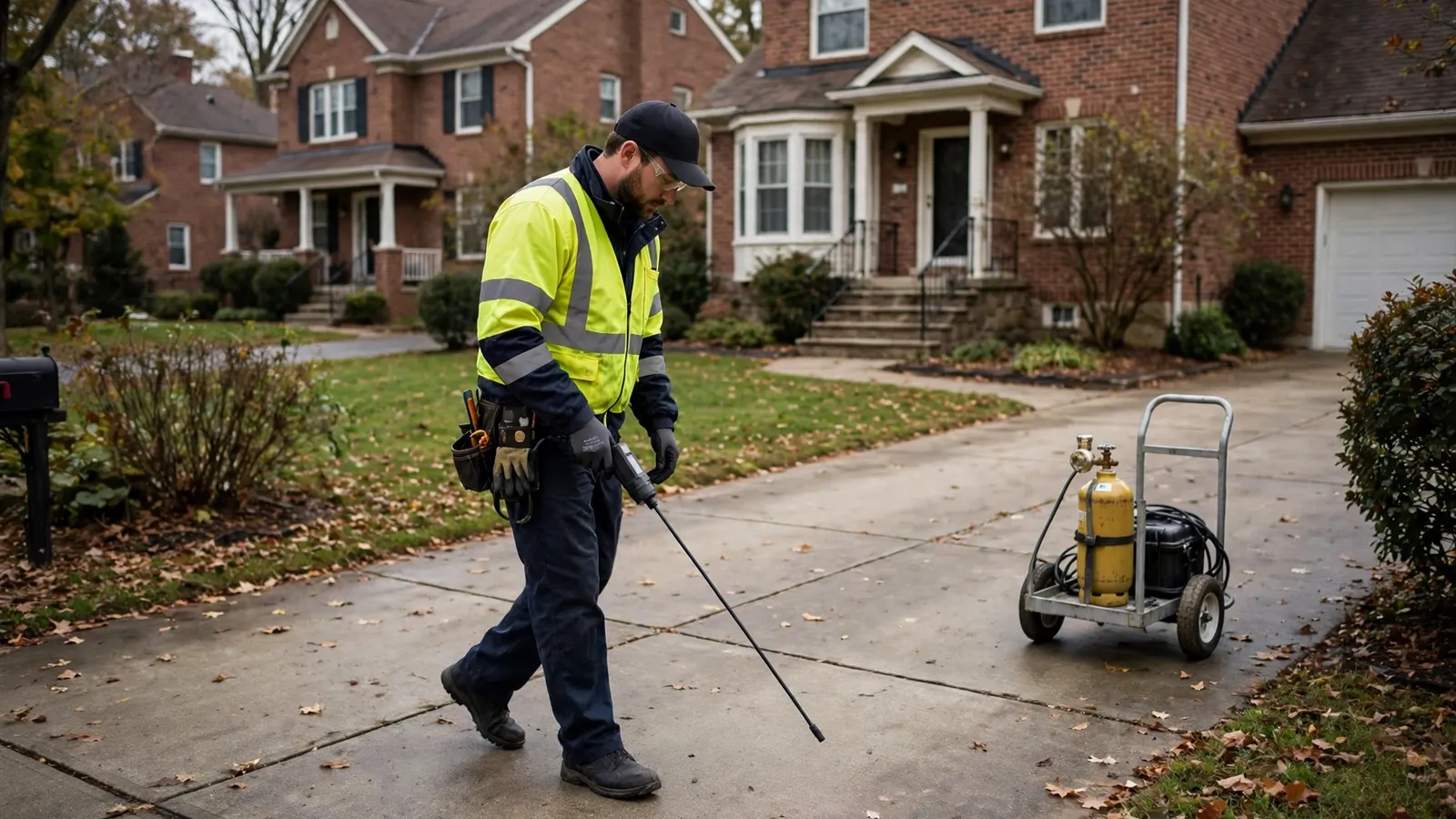
Tracer Gas Leak Detection in Camden, NJ

Here's the short version: tracer gas leak detection fills your pipe with a harmless mix of 5% hydrogen and 95% nitrogen — hydrogen is the lightest, least viscous gas there is, so it slips through even the smallest leak and rises near-vertically to the surface, where a hydrogen-selective detector sniffs it out. The detector ignores almost everything else (background hydrogen in air is only about 0.5 ppm), so it can find gas escaping through asphalt and concrete from leaks far too small for any other method. It's roughly ten times more sensitive than helium sniffing — which is why tracer gas leak detection is the precision finisher in the toolkit.
How Tracer Gas Leak Detection Works: Isolate, Charge Low & Sniff the Surface
The field procedure is standardized — the Variotec 460 manual lays it out step by step, and every serious operator follows the same shape:
- Isolate and drain the section to test. The system gets sealed so the only way out for the gas is through the leak.
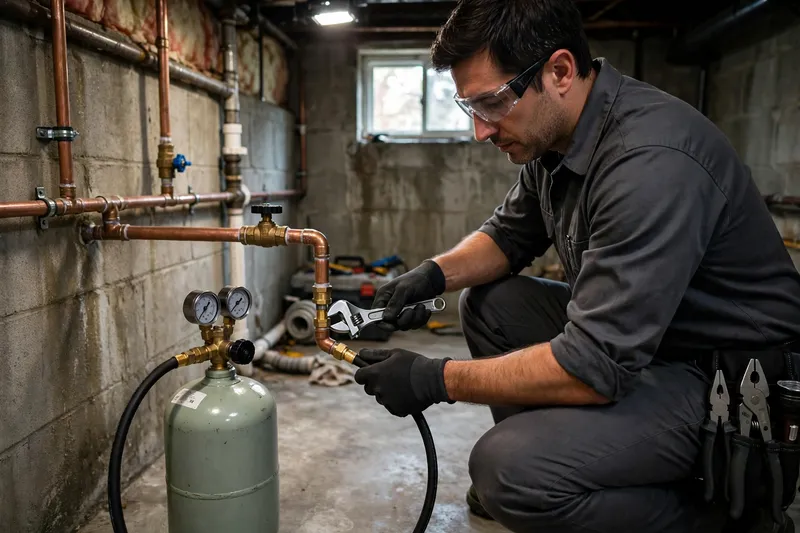
- Charge it low. The cylinder connects and the line is pressurized gently — INFICON's guidance says inject at low pressure, around 0.5–1 bar at one end, releasing at the far end to confirm the full length is filled.
- Wait. When the cylinder pressure gauge steadies, the system is only losing gas through the leak. Patience is the method — the tiny molecules need time to seep up through concrete.
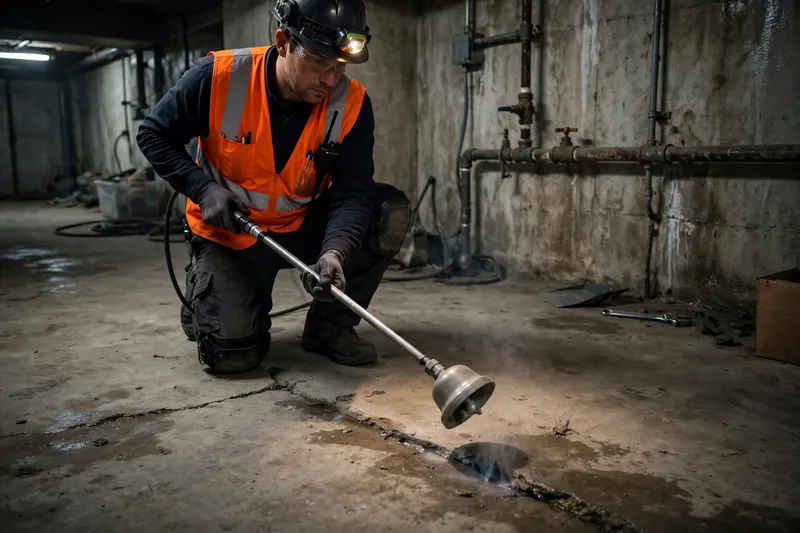
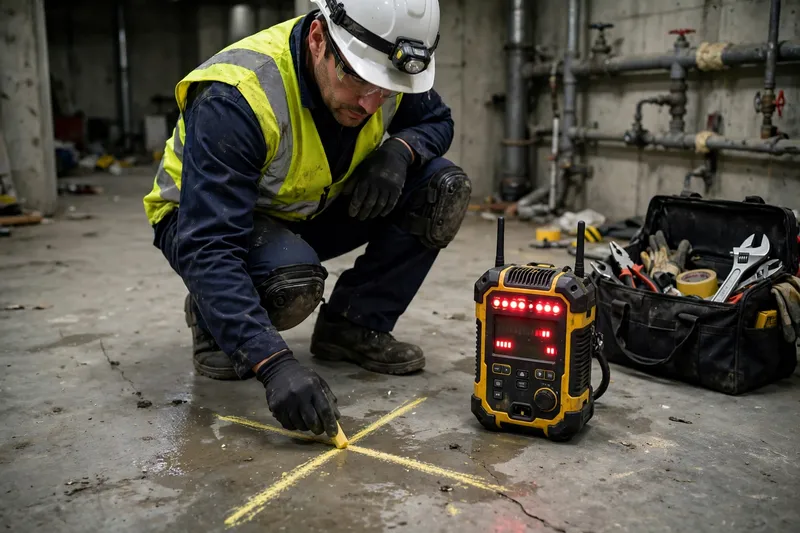
- Walk it. The tech walks the area with the detector on its most sensitive setting, bell probe drawing vacuum samples. Highest reading = the leak. Confirm by moving away (reading drops) and coming back (reading rises again).
Master plumber Dave Yates, writing in Contractor Magazine, gives the field rule that governs the whole test: "Low pressure rules the day! Start with a single low-pressure charge and don't continue to feed gas into the system." Flooding the site with gas contaminates the area and muddies every reading. And when the job's done, there's no venting to worry about — the mix is inert and nonflammable, so it stays in the line or dissipates harmlessly.
One honest note on procedure: one detector manufacturer's training video claims you don't need to drain the line before tracer gas leak detection. The industry standard — INFICON, Variotec, and every trade source — says drain and isolate. We side with the standard, not the marketing.
Where Tracer Gas Leak Detection Shines: Plastic Lines & Low-Pressure Leaks
Contractor Magazine's slab-leak guide gives the single best summary of where this method belongs: "Tracer gas shines where acoustic struggles: on plastic lines and low-pressure situations… It is slower to set up but hard to argue with." The pro rule behind that: no single detection method is right for every leak, so we confirm with a second before marking a spot. Acoustic is the workhorse, thermal narrows the zone fast on hot-side leaks — and tracer gas is the precision finisher.
The physics behind tracer gas leak detection is straightforward. Plastic pipe — PVC, PEX, polybutylene, polyethylene — damps acoustic energy badly; research puts a 6-inch PVC main's leak sound at just 10–40 Hz, attenuating fast with distance. A quiet or low-pressure leak gives a microphone nothing to hear. But gas still escapes — and hydrogen doesn't care what the pipe is made of. INFICON's own guidance lists the ideal cases: leaks that are small or hard to find, water running through nonmetallic pipe, small-volume pipe runs like submains and service lines, and jobs where the pinpoint has to be precise. Typical precision: about ±1 meter, confirmed by the move-away-and-return check.
A UK building-trade case shows what that precision looks like in practice: technicians drained a system, charged it with tracer gas, and by 11 PM had pinpointed four separate leaks under concrete from a 6 PM start. Excavation found all four — incorrect fittings, every one. One evening, four leaks, zero exploratory demolition. That's the value math: detection at $150–$600 (the honest bundled range — nobody sells a tracer gas test as a line item) versus exploratory demolition and misdiagnosed repairs that run into five figures once mold remediation enters the picture.
The Honest Limits of Tracer Gas Leak Detection: Frozen Ground, Tarmac & Marble
Tracer gas is the most precise tool we carry, and it still has conditions where it struggles. You should know them before you pay for it.
- Permeation depends on what's above the pipe. Concrete is porous — gas typically surfaces from 5 feet down in about an hour. Tarmac takes several hours. Frozen ground, especially clay, can block migration entirely. Marble floor coverings make it nearly ineffective.
- Poor-permeation workarounds exist. In tough ground we drill small bore holes to accelerate the gas — or we fall back to acoustic. The method serves the answer, not the other way around.
- Setup is slower than acoustic. Drain, isolate, pressurize, wait for migration. What you trade in time you get back in precision.
- The detector has to be good. Gas detectors should read at or below ~50 ppm for best precision; cruder devices work, but the pinpoint gets fuzzier. Ours don't.
The winter caveat matters in New Jersey: in mid-winter, frozen ground can block tracer-gas migration outdoors, particularly in clay pockets. We'll tell you straight if the season argues for a different method that day — tracer gas leak detection is the right answer most of the year, not a religion.
Don't Confuse It With Fuel Gas
Worth saying once, plainly: the tracer gas we use for water lines is a hydrogen-nitrogen mix — inert, nonflammable, nontoxic (it's even approved as a food additive). Natural-gas leak detection is a completely different test — fuel gas, permits, the gas company's involvement, and our separate gas leak detection service. If you smell gas, that's a 911-and-utility call, not a tracer-gas visit. The 5/95 blend is nonflammable by standard — anything under 5.7% hydrogen in nitrogen can't ignite per ISO 10156 — which is exactly why the industry settled on this ratio instead of pure hydrogen.
The Camden Angle: Basements, Plastic Lines, and Old Repipes
Here's the honest local framing, same as our slab page: basements dominate New Jersey housing — roughly 90% — and slab-on-grade is around 5%. So in Camden, tracer gas isn't for ranch houses on slabs. It's for leaks under basement floors and garage slabs, hydronic and radiant heating loops, and buried plastic water service lines — the cases where acoustic goes quiet and the sniffer earns its keep.
The plastic-line pattern is real and local. An NJ plumber's job video documents it directly: "this customer's underground water line was poly (plastic) instead of K copper, leading to a pinhole leak." Poly piping goes brittle underground over time. And there's a second plastic story in Camden's housing stock: with about 63% of homes built before 1950, many were replumbed in the 1980s–90s with polybutylene — the gray plastic pipe that reacts with chlorinated municipal water, turns brittle, and fails at fittings. If your home was replumbed in that era, check for gray plastic pipe: on a Poly-B system, a sniffer beats a microphone every time, because acoustic is weak on plastic and tracer gas doesn't care about material.
Soil and season cut both ways here. South Jersey's sandy soil lets gas permeate relatively well — better than clay. But NJ freeze-thaw winters are the counterpoint, as noted above. And one legitimate local hook: NJ American Water has been replacing aging Camden mains — 6-inch to 12-inch ductile iron on 27th Street, plus 160 utility-owned service lines in one project. That's the utility's side of the meter. If your bill is climbing while the street gets new pipes, the leak is on yours — and that's the half tracer gas leak detection finds.
What Our Visit Looks Like
We confirm it's a tracer-gas job. Not every leak needs the sniffer — if acoustic or thermal will answer it faster and cheaper, we say so. In our stack, tracer gas leak detection is the precision tool, not the default.
We isolate, drain, and charge low. The suspect section gets sealed off, drained, and charged with the 5/95 mix at low pressure. One charge, then patience — per Dave Yates' rule.
We walk the surface. Detector on maximum sensitivity, bell probe sampling, highest reading marked — then the move-away-and-return confirmation before anyone marks a spot for repair.
You get the mark. Typically within about a meter. The repair crew digs once, in one place. That's the entire value proposition.
Where We Work
We're Camden-based — Whitman Park, Cramer Hill, Parkside, Fairview, Bergen Square, North and South Camden, all of it — plus Cherry Hill, Pennsauken, Gloucester City, Collingswood, Haddonfield, Voorhees, and Bellmawr. If someone already tried and failed to find your leak, we're the second opinion that usually closes the case.
Tracer Gas Leak Detection in Camden, NJ: What the Sniffer Test Covers
A tracer gas test is really four jobs wearing one coat. Here is what each one involves — and why this is the test that finds the leaks every other method gave up on.
Plastic Pipe Leak Location
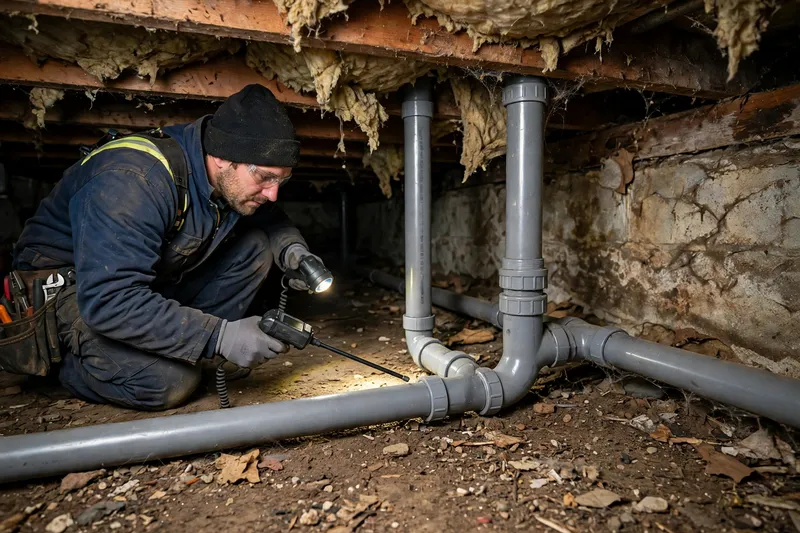
PVC, PEX, and polybutylene damp acoustic energy badly — a quiet plastic line gives a microphone almost nothing to hear. Hydrogen doesn’t care what the pipe is made of: it escapes through the smallest fitting failure and rises to the surface, where our detector finds it. On Camden’s 1980s–90s polybutylene repipes, the sniffer beats the microphone every time.
Low-Pressure & Slow Leak Location
A small, slow leak at low pressure is the case other methods miss — too quiet to hear, too faint to image. Tracer gas is roughly ten times more sensitive than helium sniffing, and the detector works down near background levels, so it catches leaks far too small for any other method we carry. The field rule still governs: one low-pressure charge, then patience.
Under-Slab & Buried Line Tracing
In Camden, the buried work is mostly under basement floors and garage slabs, and along buried plastic water service lines. The gas migrates up through concrete — typically surfacing from about five feet down in about an hour — and South Jersey’s sandy soil lets it permeate relatively well. Where tough ground fights us, we drill small bore holes to help it up.
Second-Opinion Leak Tests
If someone already tried and failed to find your leak, this is usually the test that closes the case. One documented job drained a system, charged it, and pinpointed four separate leaks under concrete in a single evening — excavation found all four, with zero exploratory demolition. Our pinpoint typically lands within about a meter, confirmed by the move-away-and-return check.
Tracer Gas Leak Detection FAQs for Camden Homeowners
The mix we use is 5% hydrogen and 95% nitrogen, and anything under 5.7% hydrogen in nitrogen is classified nonflammable — the nitrogen dilutes it past the point of ignition. It's also nontoxic and noncorrosive, and there's no venting needed afterward. A leak of the tracer gas itself is not a hazard.
That's the classic Camden use case. Hydrogen is the lightest, least viscous gas there is — it rises near-vertically through concrete, and the detector is selective enough to pick it up from very small leaks. Under basement floors and garage slabs is exactly where tracer gas earns its keep.
Completely different test. We use an inert hydrogen-nitrogen mix to find water-line leaks. Natural-gas detection deals with fuel gas — different equipment, permits, and the utility's involvement. If you smell gas, call 911 and the gas company first; that's our separate gas leak detection service.
Better than the alternatives. Plastic pipe damps acoustic signals badly, which is why microphones struggle on PVC, PEX, and polybutylene. That's the core advantage of tracer gas leak detection: it doesn't care what the pipe is made of — the hydrogen escapes and rises regardless. On plastic, the sniffer beats the microphone.
Longer than acoustic — there's no way around drain, isolate, pressurize, and wait for the gas to migrate. A UK case had four leaks pinpointed under concrete in one evening from a 6 PM start. You're trading setup time for a mark that's typically good to about a meter.
Honest answer: frozen ground can block the gas from migrating, especially in clay — mid-winter outdoor testing may need small bore holes or a different method entirely. We'll tell you on the day if the season argues against it rather than selling you a compromised test.
Typically about ±1 meter, confirmed by moving the probe away (reading drops) and returning (reading rises). The repair crew gets a marked spot, not a zone — one dig, one fix.
It's sold as part of a leak-detection visit, not a line item — published US detection ranges run $150–$600 depending on the job. There's no Camden-specific rate card; call (856) 245-0967 and we'll quote your situation. Compare it against the alternative: exploratory demolition that runs into five figures once mold remediation is involved.
Some Leaks Defeat Sound, Eyes, and Cameras
There is a category of leak that shrugs off the standard hunt: the pinhole in a plastic line that makes almost no sound, the break under a slab where the water sound dies in concrete, the seep so slow that no surface ever gets wet enough to image. Owners meet this category after one or two failed visits, and the frustration is specific — they have paid for certainty twice and own none. Tracer gas exists for this drawer of problems. A safe hydrogen-nitrogen mix goes into the line, escapes only where the leak is, and rises through concrete, soil, and flooring to a detector sensitive enough to find it. It is slower than listening and it is not the first tool out of the truck. It is the one that ends hunts the other tools could not.
The test, in the order the manual prescribes
Who Calls Us for the Gas Test
By the time this method comes up, the caller has usually met the leak before — through other people’s failed attempts to find it.
Owners whose leak survived other methods
An acoustic visit that found nothing conclusive, a camera that showed a cold patch and no source — you need the method that does not depend on sound or surface temperature at all. If the line can be isolated and charged, the gas will leave through the leak and nowhere else.
Owners with plastic pipe and a moving meter
Plastic is where listening goes to die: the material absorbs the leak’s sound before it travels. For PEX and PVC systems — most newer construction and every repipe — the gas test is often not the last resort but the correct first serious method.
Landlords & property managers
A unit that cannot be torn apart on spec — tenants in place, finishes you would rather keep — needs a pinpoint that justifies one small opening. A documented gas test, with the reading confirmed by the move-away-and-return check, is the evidence that the opening belongs exactly where it is made.
A Leak Nobody Can Find? We'll Trace It.
Every day a hidden leak continues, the damage — and the bill — grows. Call Leak Fix Pros now and get answers, not guesswork.
- Non-invasive pinpoint detection
- Upfront pricing, no surprises
- Serving Camden, NJ and nearby towns
Get Your Free Quote
Free quote · No obligation