Thermal Imaging Leak Detection in Camden, NJ

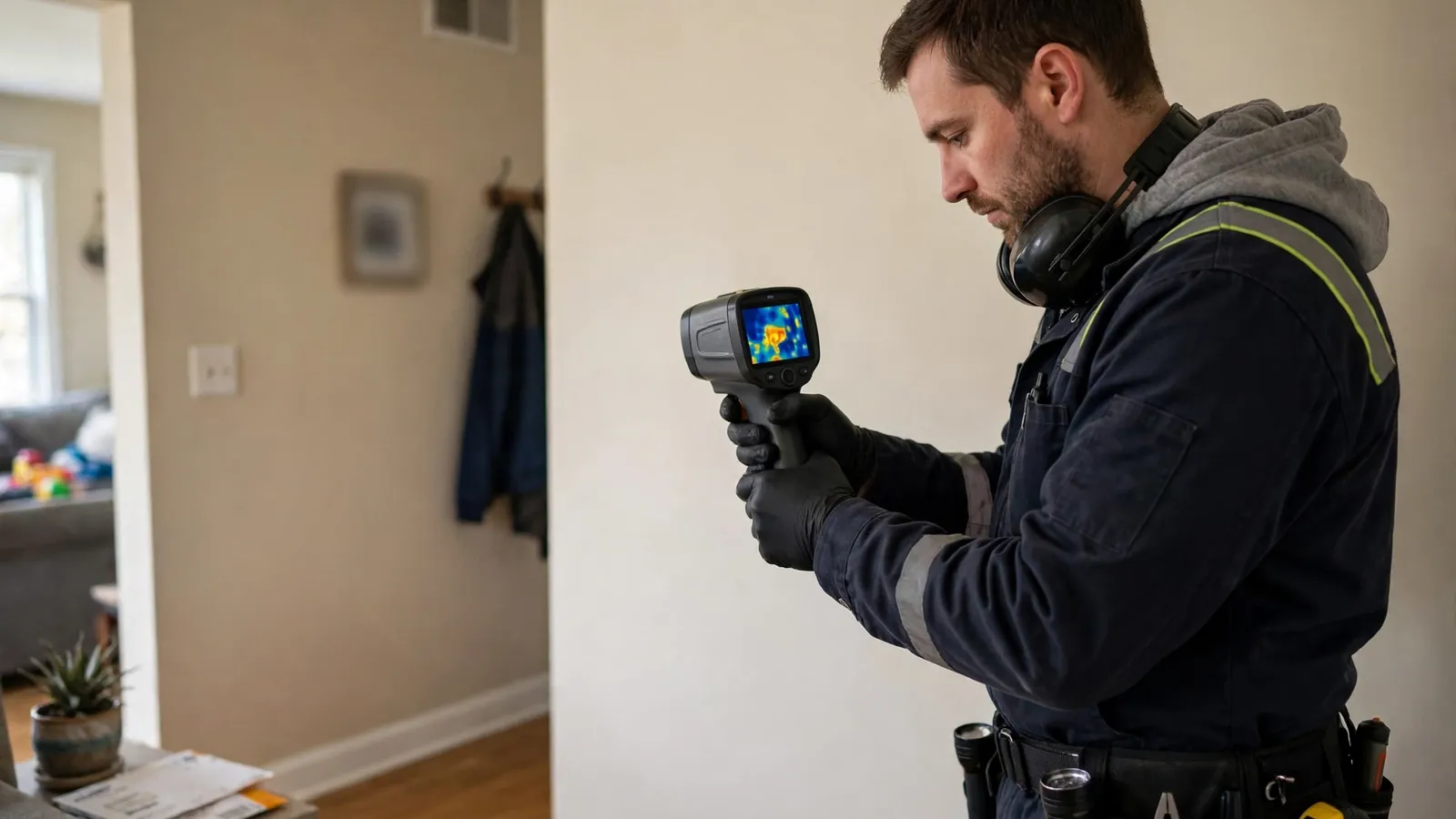
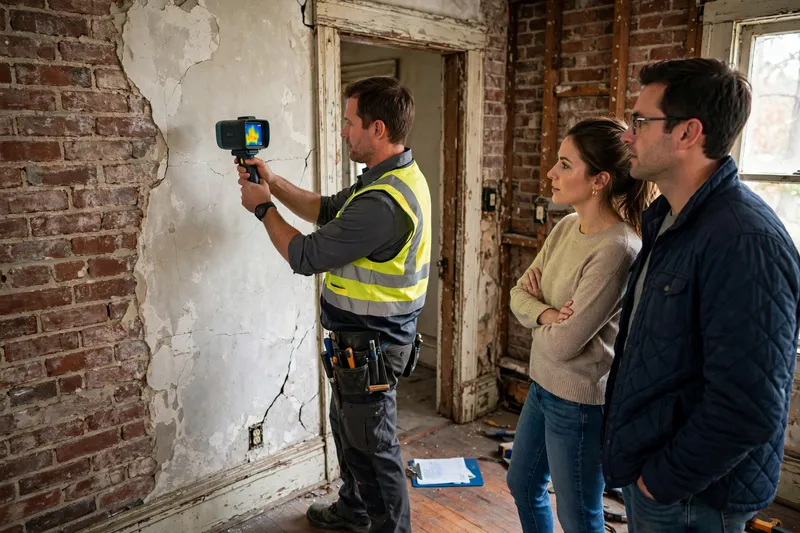
Here's the short version before we get into the details: thermal imaging leak detection doesn't see water, and it doesn't see through walls. It reads surface temperatures — and hidden moisture changes them in patterns a trained eye can read. A wet patch inside your wall runs 3–6°F cooler than the dry wall around it while it's evaporating. That's the entire science, and in the right hands it's one of the most useful non-destructive tools in leak work.
What the Camera Is Actually Reading
Moisture shows up on a thermal camera through two behaviors. The first is evaporation — a wet surface that's actively drying reads cooler than its surroundings. The second is thermal inertia — wet material changes temperature more slowly than dry material, so during a heating or cooling swing the wet spot lags behind. That means a cold spot and a warm spot can both be moisture, depending on when you scan. Field research on building inspections has visualized leaks at temperature gradients of roughly 0.4–1.5°C, where the wet material ran cooler.
FLIR's own guidebook sets the working rule for reliable scans: at least 10°C (18°F) of inside-to-outside temperature difference, and take note of whether there was a big temperature swing in the 24 hours before. Modern cameras resolve differences down to about a tenth of a degree Fahrenheit — but resolution means nothing without the operator knowing what to ignore.
A UK thermal-leak specialist, DCI Leak Detection, puts the core truth bluntly: "A thermal camera does not see water, and it does not see through walls. It sees the temperature of the surface in front of it, nothing more… An experienced operator knows when the conditions are wrong and says so, rather than handing you a pretty picture that proves nothing." That's our standard too. When we do thermal imaging leak detection on your home, the camera is the first pass — every anomaly we find gets confirmed with a moisture meter before anyone talks about cutting drywall.
The Honest Limits of Thermal Imaging Leak Detection: Cold Lines, Deep Slabs & Reflections
This is the section most leak companies won't write. Here it is anyway.
- Cold-water leaks are hard. A small leak, a cold-water leak, heavily insulated pipework — these produce little or no usable thermal contrast, because there's no meaningful temperature difference to image. MML Plumbing in London says it plainly: they don't rely on thermal imaging alone for exactly this reason.
- Depth and insulation mask the signal. A deep concrete slab, thick insulation, or a suspended floor with an air gap all slow the heat reaching the surface. The deeper the moisture, the fainter the pattern.
- Weather can spoil the scan. Direct sun on a wall, a room that was just heated, or rain-soaked exterior surfaces can swamp the anomaly entirely.
- Reflections lie. Glossy paint, metal trim, foil-faced insulation and glazed tile reflect surrounding temperatures and read falsely hot or cold. The pro check is simple: step aside and re-image. A true anomaly stays put; a reflection moves.
And the rule that governs everything: an anomaly is a lead, not a verdict. That's how the leak-investigation firm PCLA frames it, and FLIR's own training agrees — suspect areas get confirmed with moisture-meter readings, pressure testing, acoustic investigation, or tracer gas before anyone opens a wall. One DIYnot forum homeowner learned this the hard way, pointing a phone thermal camera at a leaking underfloor-heating loop and getting "a mass hot area showing across the whole floor" with zero pipe definition — the screed, adhesive, and tiling mat blurred everything. Contractor Magazine's leak-sleuthing column is equally blunt about slab work: even with the infrared cameraman arriving before sunup, "the only way to confirm" a tough one can be "destructive exploratory surgery." We tell you this so you know what you're buying: thermal imaging leak detection done honestly, not thermal theater.
Where Thermal Imaging Leak Detection in Camden Earns Its Keep: Walls, Ceilings & Flat Roofs
Now the good news — the scenarios where thermal imaging leak detection genuinely shines, including the ones we see most in Camden homes.
Walls and ceilings are the bread and butter: the camera sweeps a room as a non-destructive first pass, cool spots get meter-verified, and you get a moisture map instead of exploratory holes. One home inspector's trick we use regularly: run hot water into the upstairs bathroom fixtures, then scan the ceiling below — traps buried in ceilings drip in ways that never show on the surface, and he's "found how many leaks" that way, saying he "would not have found that without an IR camera."
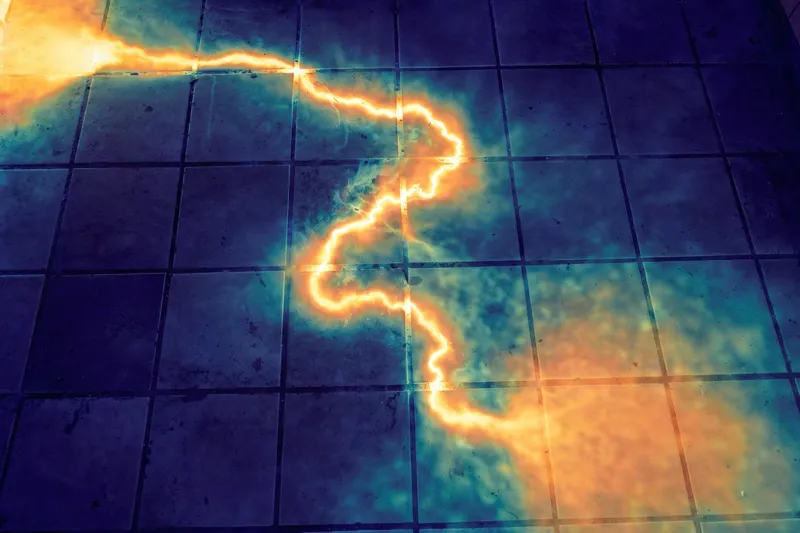
Under-slab and underfloor heating lines are the specialist's signature work — hot-water slab leaks draw the clearest thermal signature of all, a warm trail across the floor. (One condo case made the tile so hot "you could barely walk on them barefooted.") Cold-side slab leaks are the harder case — see the limits above — which is why we pair methods rather than betting on one.
Flat and low-slope roofs get the after-sunset method: during the day wet insulation soaks up heat, and after sunset the dry areas cool fast while the wet ones hold their warmth, showing as warm spots. The working window is one to three hours after sunset, with clear skies, minimal wind, and no rain in the prior 24 hours. The formal standard is ASTM C1153 — and anomalies still get verified by core sampling before a roofer spends your money.
The Camden-specific honest note: about 63% of Camden homes were built before 1950, which means plaster-and-lath walls — thick, dense plaster that a thermal signal has to cross before it reaches the camera. Thermal imaging leak detection still works on plaster, but we scan slower and lean harder on the moisture meter to confirm. And in winter, the scan that pays for itself most is the attic and ceiling work after ice dams — meltwater backing up under shingles and into wall cavities is exactly the kind of hidden spread a camera maps well.
Thermal Imaging Leak Detection in Camden, NJ: What a Scan Actually Covers
A thermal scan is really four jobs wearing one coat. Here is what each one involves — and why the map matters more than any single picture.
Hidden Moisture Mapping
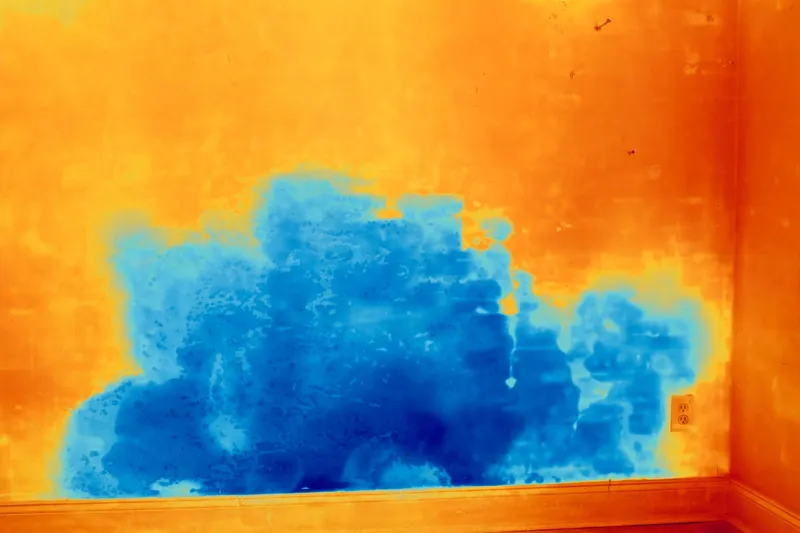
We sweep walls and ceilings as a non-destructive first pass: a wet patch inside a wall runs 3–6°F cooler than the dry wall around it while it evaporates, and the camera draws that pattern. Every cool spot then gets confirmed with a moisture meter, so you end up with a moisture map of the room instead of exploratory holes in your plaster.
Hot Water Line Tracing
Hot-water lines are the camera’s clearest work. A leaking hot line under a slab or floor draws a warm trail we can follow across the surface — one condo case made the tile so hot you could barely walk on it barefoot. Cold-side lines are the harder case, which is exactly why we pair the camera with the meter rather than betting the answer on one method.
Stain Size & Spread Scans
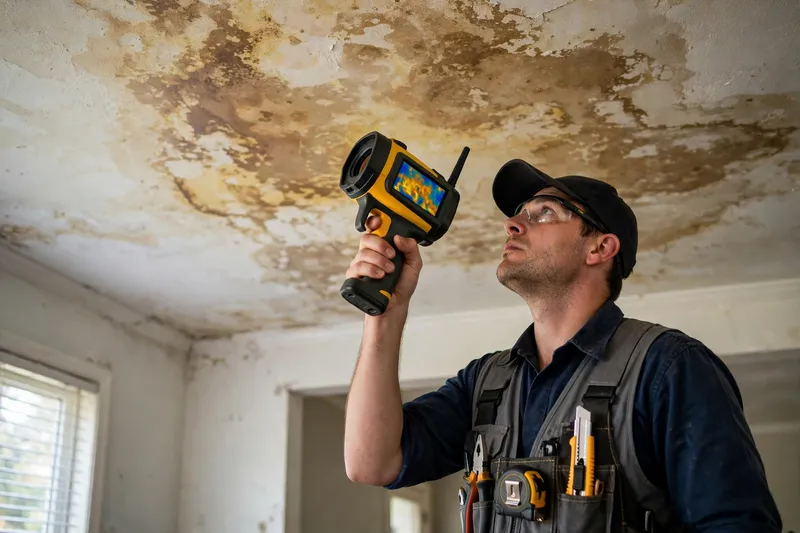
The stain you can see is rarely the whole story. We scan well past its edges to find where the moisture actually stops — the streaks, plumes, and cool boundaries that trace how the water moved through the wall or ceiling. That true size and spread is what your repair should be based on, and it is exactly the documentation an insurance adjuster wants to see.
Pre-Purchase Moisture Scans
About 63% of Camden homes were built before 1950, and thick plaster-and-lath hides moisture well. A scan before you buy maps what is wet behind those walls — including the attic and ceiling spread that follows winter ice dams. We scan slower on plaster and lean harder on the meter to confirm, but a mapped surprise before closing beats an inherited one after it.
What It Costs to Scan a Home for Hidden Moisture in Camden, NJ
No Camden-specific rate cards are published for thermal imaging leak detection, so here are attributed national and other-market ranges — what they are, not what we'd charge.
| Service | Published range | Source |
|---|---|---|
| Basic IR inspection (~15–20 min) | $375–$575 | LA leak-detection firm rate card |
| Detailed inspection (up to 1 hr, ~3,000 sq ft) | $575–$775 | Same firm |
| Multi-unit / water-intrusion testing | $975–$1,850+ | Same firm |
| Thermal add-on to home inspection | $150–$250 | Inspector trade forums |
| Independent thermographer call-out | $300 minimum; ~$450 first hour | inspectionnews.net; Contractor Magazine |
For context on why the service costs what it does: a pro-grade camera alone runs $2,000 to $15,000+, and inspectors who charge for thermal assessment train to Level I/II thermographer standards. The camera is the cheap part of knowing how to read it. Our thermal imaging leak detection visits are priced as a detection service, not by the hour — you pay for the answer, not the equipment rental.
What Our Visit Looks Like
We set up the conditions. About an hour before camera time, we'll have you nudge the thermostat up or down — forcing a temperature swing accentuates the anomalies. The camera itself needs to acclimate to the room before it reads true.
We scan slow, span tight. The camera moves slowly at a steady angle, with a tight temperature span so small differences show. Fast sweeps and wide spans hide the subtle patterns — streaks, plumes, mottled patches, cool boundaries — that trace how moisture moved.
We confirm everything. Every anomaly gets a moisture-meter reading. The camera narrows; the meter verifies. That's the whole discipline of thermal imaging leak detection: find it without opening a single wall, then prove it before anyone cuts one.
You get a map. We walk you through what we found, where it is, and what it means — including the areas that scanned clean. Ruling sections out is part of the service. If you end up filing an insurance claim, the moisture map is exactly the documentation adjusters want to see.
Where We Work
We're Camden-based and we scan homes and businesses across the city — Fairview, Bergen Square, Parkside, Whitman Park, Cramer Hill, North and South Camden — plus Cherry Hill, Pennsauken, Gloucester City, Collingswood, Haddonfield, Voorhees, and Bellmawr.
Thermal Imaging Leak Detection FAQs for Camden Homeowners
No — and anyone who says otherwise is selling something. The camera reads surface temperatures; hidden moisture changes them in recognizable patterns. In Camden's pre-1950 plaster homes we scan slower and always confirm with a moisture meter, because thick plaster can mask a faint signal.
Honestly: maybe not. Small leaks, cold-water leaks, and heavily insulated pipework can produce little or no usable thermal contrast — there's no temperature difference to image. That's why we pair thermal with acoustic listening or tracer gas rather than betting the visit on one tool.
No — that's the entire point. The camera plus a moisture meter locates and verifies without demolition. We only recommend opening anything after the moisture map says exactly where, and even then it's your call.
Nationally, basic IR inspections run $375–$575 and detailed ones $575–$775 at published rate cards; home inspectors charge $150–$250 as an add-on. There's no published Camden-specific pricing — call (856) 245-0967 and we'll quote your job, not a national average.
When indoor and outdoor temperatures differ — early morning or after sunset. For flat roofs, the window is one to three hours after sunset with no rain in the prior 24 hours. Avoid scanning right after a heating cycle or with direct sun on the wall.
Yes, with caveats. Dense old plaster slows the thermal signal reaching the surface, so we scan slower, force a bigger temperature swing, and lean harder on moisture-meter confirmation. About 63% of Camden homes are pre-1950, so this is our normal working condition, not an exception.
A $200 phone attachment is qualitative — useful for curiosity, not for diagnosis. In professional thermal imaging leak detection, pros use 384×288 resolution or better and train to Level I/II thermographer standards, because most of the skill is knowing what to ignore: reflections, sun loading, normal thermal bridging.
You get a moisture map showing exactly what's wet and what scanned clean, plus meter readings for the record. If it's an insurance situation, that documentation is what adjusters need. What you do next — dry it, repair it, file a claim — is your decision, and we'll tell you plainly what we'd do in your shoes.
A Camera That Shows You a Picture You Cannot Read
Thermal imaging suffers from its own demos: the rainbow picture looks like an X-ray, so owners expect it to see through walls. It cannot. The camera reads surface temperatures, and a wet area reads cooler — which makes it a superb way to map how far moisture has spread and a poor way, on its own, to prove where the water came from. The frustration we meet is the scan that produced a beautiful image and no conclusion: a cold patch that could be a leak, missing insulation, or an air gap, with the bill arriving anyway. Used honestly, the camera is one witness among several — it draws the map, and then a moisture meter and a pressure test cross-examine it. Sold as the whole investigation, it is an expensive screensaver.
Thermal work, priced by how deep the look goes
Who Calls Us for a Thermal Scan
The camera earns its keep in specific situations — these are the callers standing in one.
Owners chasing a stain’s true size
The visible stain is the part of the moisture that reached the surface. You need the spread mapped — how far the damp actually travels inside the wall or ceiling — because that map is what decides whether the repair is a patch or a strip-out, and it is the document an insurer reads.
Owners with a leak that will not localise
Intermittent leaks — the ones that only appear in wind-driven rain, or when a particular fixture runs — defeat guesswork. A scan taken while the system is provoked can catch the moisture path in the act, narrowing the hunt before any other method is aimed.
Landlords & property managers
Between tenancies and after repairs, a documented scan gives you a condition record with pictures: moisture present or absent, in the file, dated. When a tenant reports a stain three months later, the file — not anyone’s memory — says whether it is new.
Suspect Hidden Moisture? We'll Scan It.
Every day a hidden leak continues, the damage — and the bill — grows. Call Leak Fix Pros now and get answers, not guesswork.
- Non-invasive pinpoint detection
- Upfront pricing, no surprises
- Serving Camden, NJ and nearby towns
Get Your Free Quote
Free quote · No obligation