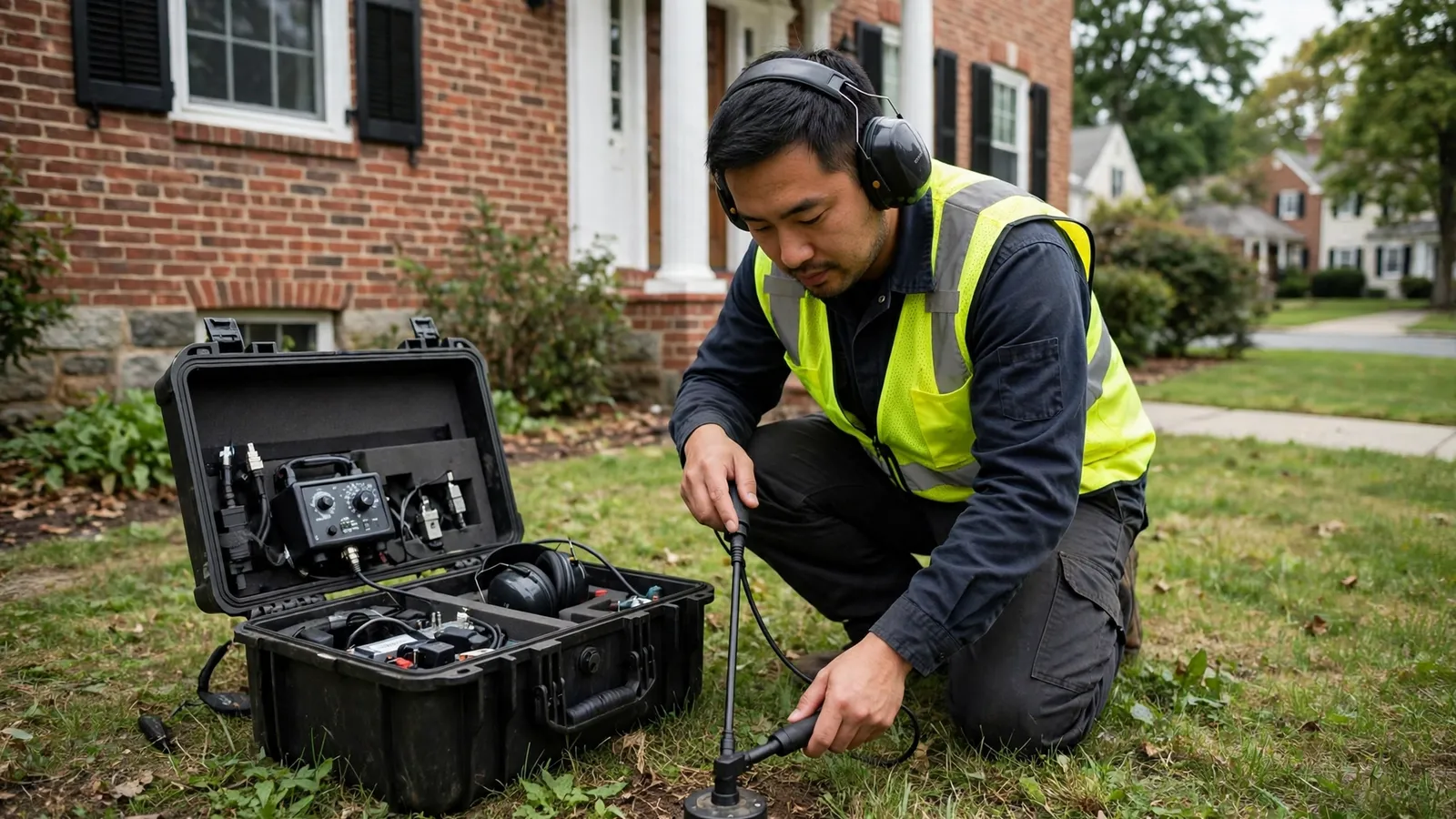
Acoustic Leak Detection in Camden, NJ

A pressurized pipe with a crack in it makes noise — water hissing through the break, humming through a loose joint. The turbulence where inside pressure meets outside pressure sends vibration two ways: along the pipe itself and outward through the soil. The closer the sensor gets, the sharper the signal. Acoustic leak detection is the discipline of reading that sound: confirm the leak exists, survey the route, then pinpoint the epicenter — usually without breaking ground until the shovel has exactly one place to go.
How Acoustic Leak Detection Finds a Leak by Listening
The pro sequence runs in three steps, and skipping the first one is how amateurs waste your money:
- Confirm the leak exists. A pressure-holding test, or watching the water meter with every fixture isolated. If the meter moves with nothing running, water is going somewhere it shouldn't.
- Survey the route. The tech sweeps accessible contact points — the water meter, curb stop, house valve, exposed tees and elbows, wall penetrations — with a listening stick or contact microphone, watching live spectrum bars and listening through noise-cancelling headphones. A sustained rise in amplitude marks the suspect zone.
- Pinpoint. Switch to the ground microphone and compare signal strength across adjacent points — the highest, most stable signal is the epicenter. For buried lines, a leak noise correlator does the math: two sensors clamped to the pipe at two known points record the same leak sound, the unit measures the time delay between them, and — given the pipe's material, size, and sensor spacing — computes the leak's position in feet and inches from each sensor.
Two details separate pros from equipment owners. First, the correlator needs to know the pipe material and size — sound travels at known, material-specific speeds, and if the material is unknown it has to be measured on site or the location will be off. Second, a strong signal isn't always a leak. Turbulence at open valves, pressure-reducing stations, pump cavitation, and resonance in metal structures can all mimic leak noise. Modern analysers tell them apart — short-lived environmental noise shows as thin, fluctuating bars; a real leak is thick, stable, and continuous. As one trade piece puts it, this is why the operator matters more than the box.
The best listening happens overnight, when traffic, trains, and weather go quiet — and the best listening point is a distribution pipe or valve, not a hydrant, where there's less interference. On a residential visit we work in daytime, but we listen at contact points rather than relying on surface sweeps. At utility scale, the same method runs as noise loggers: sensors left on network fittings for hours, flagging high continuous noise for a correlator crew to pinpoint. One trade-press case study tells the acoustic leak detection story at its best — engineers surveyed a Houston plant's fire-protection system with pumps and machinery running, pinpointed the leak in three hours without excavation, and the plant ordered the same survey for the rest of the system.
Metal vs Plastic: The Honest Divide
Here's where an honest company earns its keep, because acoustic has a real weakness and you should know it before you pay for it.
| What you're listening to | Typical frequency | What it means |
|---|---|---|
| Leak in copper, steel, or cast iron | 500–1,500 Hz | Metal transmits well — acoustic's home turf |
| Ground-borne sound reaching the surface | 30–700 Hz | Soil acts as a low-pass filter; only low frequencies surface |
| Leak in PVC pipe (general) | 70–850 Hz | Harder: plastic damps sound, needs more sensors closer together |
| Leak in a 6" PVC main (NRC research) | 10–40 Hz | Near or below human hearing — conventional listening fails |
Metal pipes are acoustic's home turf. Copper, steel, and cast iron transmit sound beautifully — sensors cling on with a magnet, and the leak's hiss sits in a clean 500–1,500 Hz band. A master plumber on the Terry Love forums describes pressing an ear to a candidate pipe: "If the leak causes turbulence this might be reasonably loud… Metal pipes transmit sound pretty well." Louder leaks are louder signals, too — research confirms flow rate and signal amplitude rise together, so a running break is unmistakable while a small weep is the hardest thing to hear.
Plastic is fundamentally harder. PVC couples more strongly with the water column than metal does, which damps the sound — it doesn't travel as far, sits lower in frequency, and correlating a leak needs many more sensors placed much closer together. National Research Council Canada work found a typical 6-inch PVC main leak humming at just 10–40 Hz — below most commercial equipment's useful range, and below human hearing entirely. Listening at a hydrant in that situation, the researchers concluded, "will be unsuccessful." For non-metal pipes, pros switch to hydrophones — water microphones inserted into the line — because, as one water-industry veteran puts it, "the sound travels down the water column, not the pipe."
Two more honest caveats from the equipment manuals. Soil is a low-pass filter: frequencies whose wavelengths are smaller than the burial depth get absorbed on the way up — only low frequencies normally reach the surface, and compact ground conducts them better than loose ground. And if a leak has run long enough to form a water blister around the pipe, ground transmission goes nearly silent; pros then feed compressed air into the line to make the leak audible again. When we do acoustic leak detection at your home, we tell you which of these apply before we start — and if plastic pipe or deep burial makes acoustic the wrong tool, we say so and reach for a different one.
Why Camden's Metal Pipes Suit Acoustic Leak Detection
Now the local part, and it's genuinely in your favor. About 63% of Camden homes were built before 1950 — the era of galvanized steel and copper supply lines. Those are exactly the high-transmission, 500–1,500 Hz metal pipes that acoustic equipment was built for. Corrosion pinholes in old galvanized under pressure produce the classic hiss; original buried service lines in freeze-thaw country give us plenty to listen to.
The soil note, honestly framed: Camden sits on the Atlantic Coastal Plain — unconsolidated sand, silt, and clay, generally sandy loam. Sandy, loose soil conducts ground-borne sound less well than compact clay. So in Camden we lean on contact-point listening — your meter, curb stop, and house valve — plus the correlator, rather than relying on ground-mic surface sweeps alone. That's method guidance, not a deficiency: the contact points are also exactly what NJ American Water's winter guidance tells you to locate and tag. Same valves, two jobs.
And the framing a veteran forum plumber gives homeowners: the water company has pinpointing equipment, "but they don't usually work on homes. A good plumber may have that tool." That's the gap acoustic leak detection fills — utility-grade listening, on residential pipe, with the repair marked to the foot.
Acoustic Leak Detection in Camden, NJ: Four Ways We Listen for a Leak
One visit, four distinct listening jobs. Here is what each one involves — and why skipping the first is how a homeowner pays for a pinpoint that was never confirmed.
Pressurized Line Listening
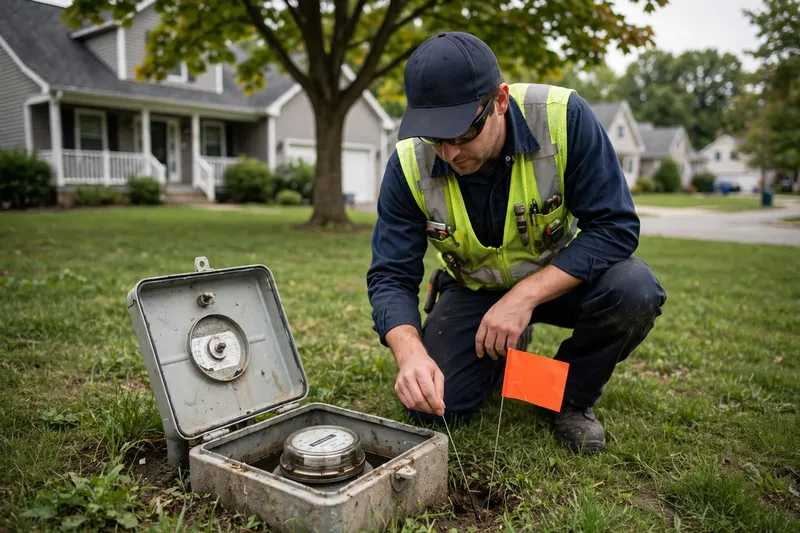
A pressurized leak announces itself — water hissing through the break, vibration running along the pipe and out through the soil. We work the contact points first: your meter, curb stop, house valve, and exposed fittings, listening stick and contact microphone in hand, headphones on. Where the signal rises and holds steady, that is the neighborhood of the break — and where the real pinpointing starts.
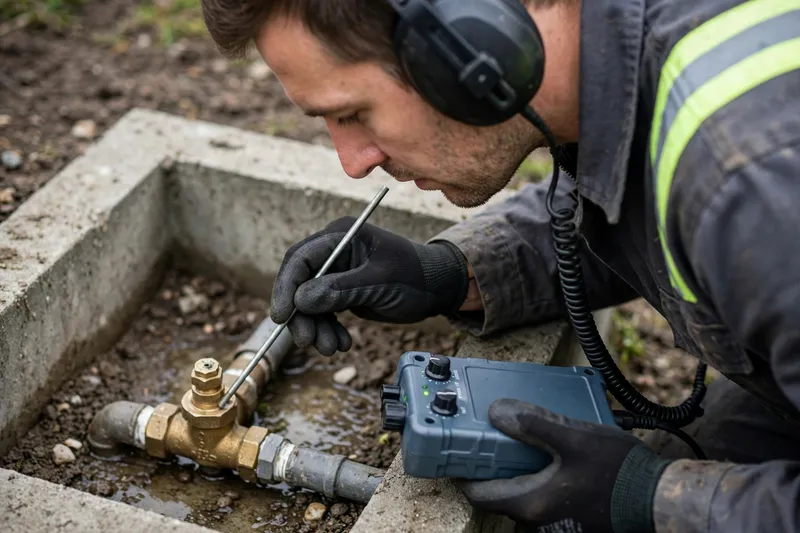
Metal Pipe Leak Listening
Copper, steel, and cast iron are this method's home turf: metal carries leak sound in a clean, high band, and our sensors cling to the pipe with a magnet. That is good news in Camden, where so much of the housing stock predates 1950 and still runs on galvanized and copper lines. Corrosion pinholes in old metal under pressure produce exactly the hiss this equipment was built to hear.
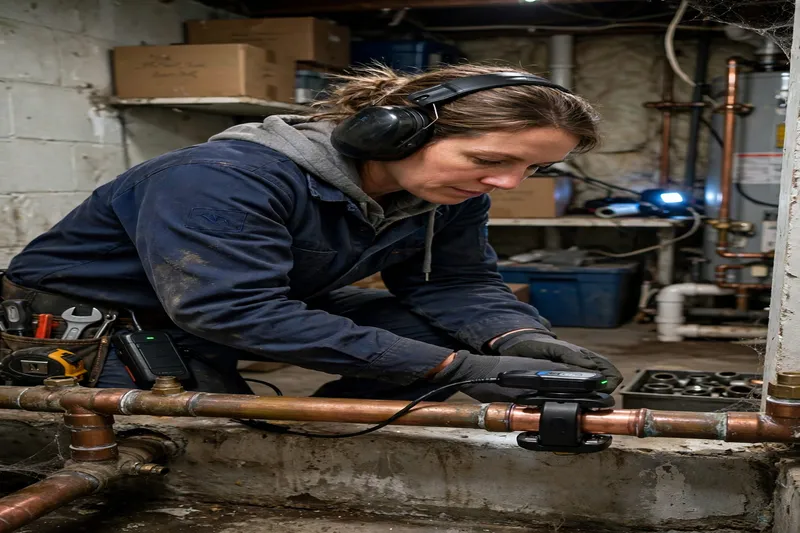
Plastic Pipe Workarounds
Plastic is the honest divide, and we do not pretend otherwise. PVC damps the sound and drops it to frequencies conventional gear barely hears, so we change tools: hydrophones that listen to the water column instead of the pipe wall, sensors set closer together, and compressed air fed into the line when a long-running leak has gone quiet underground. If your pipe stock makes listening the wrong tool, we tell you before we start, not after.
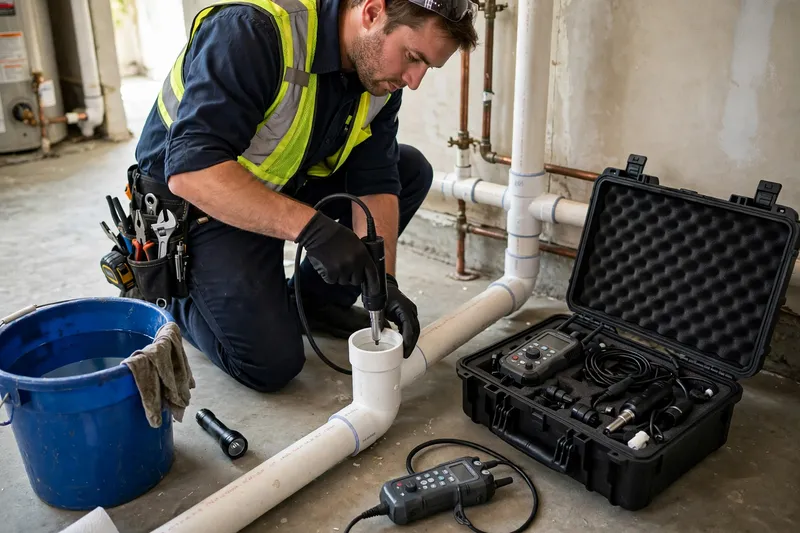
Meter-Test Confirmation & Spot Marking
Nothing gets marked until the leak is proven. We start with the meter test — everything off, and if the meter still moves, water is going somewhere it should not — or a pressure-holding test on the suspect line. Then the correlator does its math on buried runs, computes the position in feet and inches, and we mark the one spot the repair crew digs. And if the tests rule the line out instead, that is a real result too: certainty is worth money.
What Acoustic Leak Detection Costs in Camden, NJ
No Camden-specific pricing is published for acoustic leak detection. Attributed ranges from other markets:
| Service | Published range | Source |
|---|---|---|
| Specialist leak detection visit (US) | $280 average, $150–$400 | Angi 2026 |
| Leak detection + repair bundled (US) | $450–$1,250 | JMJ Plumbing, Atlanta (published) |
| Fixed detection fee (Australia) | $200–$500, or $100–$180/hr | AU pricing guide (structure reference) |
| Standard non-invasive investigation (UK) | £550 fixed; median £390 across 152 jobs | London specialist (published) |
For context on the equipment side: a municipal correlator unit runs around $30,000 — Contractor Magazine calls it "a must-have tool" for anyone entering the leak-detection business. You're not paying for the box; you're paying for the operator who knows when the signal is a valve and when it's your pipe. And one London firm's philosophy is worth quoting: "Ruling a circuit out is worth as much as finding the leak, and it is the part nobody sells." A clean bill of health on a suspect line is a real result — we treat it like one.
What Our Visit Looks Like
We confirm first. Meter test with everything isolated, or a pressure-holding test on the suspect line. No confirmation, no equipment invoice — we don't sell you a listening session for a leak that isn't there.
We survey your contact points. Meter, curb stop, house valve, exposed fittings — listening stick and spectrum bars, mapping where the amplitude rises and holds.
We pinpoint. Ground microphone across the suspect zone, correlator on buried runs where we know the material and the route. The output is a marked spot, not a general area.
You get the straight answer. Found it — here's where, here's the mark for the repair crew. Ruled it out — here's the proof, and here's what we'd check next. Either way, you know more leaving than we did arriving.
Where We Work
We're based in Camden and we cover the whole city — Parkside, Whitman Park, Cramer Hill, Fairview, Bergen Square, North Camden, South Camden, East Camden — plus Cherry Hill, Pennsauken, Gloucester City, Collingswood, Haddonfield, Voorhees, and Bellmawr.
Acoustic Leak Detection FAQs for Camden Homeowners
No — that's the point of the method. The whole survey is non-invasive: listening at contact points, ground microphone on the surface, correlator clamped to accessible pipe. Digging happens once, at the marked spot, when it's time to repair — not as part of the search.
Honestly: it's harder. Plastic damps leak sound and the frequencies drop very low — a 6-inch PVC main can hum at 10–40 Hz, below what conventional gear hears well. In that case we switch to a hydrophone, which listens to the water column instead of the pipe, and we tell you upfront when acoustic isn't the right tool.
There's no hard number — soil acts as a low-pass filter, so only low frequencies reach the surface, and compact ground conducts better than loose soil. That's why we prefer contact-point listening (meter, curb stop, valves) over surface sweeps, especially in Camden's sandy soil.
Overnight is ideal — traffic and ambient noise drop away. On a residential visit we work daytime hours and compensate by listening at contact points rather than open ground, which is far less affected by surface noise.
On a buried run with known pipe material and a mapped route, the correlator computes the position in feet and inches from each sensor, and we mark it on the surface. That's the difference between one surgical dig and a trench of guesses.
Then you've bought certainty, which is worth real money — you stop chasing a ghost and we point you at what to check next. One specialist's line we agree with: ruling a circuit out is worth as much as finding the leak, and it's the part nobody sells.
Published US ranges put a specialist detection visit at $280 on average ($150–$400); bundled detection-plus-repair runs $450–$1,250 at one published Atlanta plumber. There's no Camden-specific rate card — call (856) 245-0967 and we'll quote the acoustic leak detection visit, not a national average.
It's the right second test. First comes the meter check with everything off — if the meter moves, water is escaping on the supply side, and acoustic listening is exactly how we find where. If the meter holds steady, the problem is elsewhere (a running toilet, irrigation, a bad reading), and listening won't help.
The Frustration Is a Leak You Can Hear but Nobody Can Find
Most acoustic calls start the same way: the meter says water is moving, the homeowner can sometimes hear it at night, and there is not a wet spot anywhere to explain it. The fear underneath is demolition by exploration — floors opened on hunches. Listening exists to prevent exactly that: a pressurised leak makes a sound, that sound travels through the pipe and the ground, and the right equipment reads it to a point, not a postcode. The honest limit matters too, and this page states it plainly: metal pipe carries the sound; plastic muffles it. An operator who will not tell you which side of that divide your house sits on is selling you the visit, not the answer.
What a listening visit runs, in published figures
Who Calls Us to Listen for a Leak
The microphone is the same. What the answer has to do is different each time.
Owners with a moving meter and no water in sight
You need the hunt narrowed from “somewhere in the system” to a marked spot — and an honest read on whether your pipe stock suits the method, before the visit, not after it. Copper and galvanised lines, which this area is full of, are the cases listening was built for.
Owners told to start tearing out
When the first proposal is demolition, a non-invasive second method is the cheapest decision available. A pinpoint confirmed by sound — checked by moving away and coming back, the way the method demands — is what turns an exploratory opening into a surgical one.
Landlords & property managers
An unexplained bill in a tenanted property has three suspects: the building, the tenant’s usage, and the meter. A documented acoustic survey that isolates the building’s side — or clears it — settles which conversation you are having, with evidence instead of suspicion.
Water Running Somewhere Hidden? We'll Listen.
Every day a hidden leak continues, the damage — and the bill — grows. Call Leak Fix Pros now and get answers, not guesswork.
- Non-invasive pinpoint detection
- Upfront pricing, no surprises
- Serving Camden, NJ and nearby towns
Get Your Free Quote
Free quote · No obligation